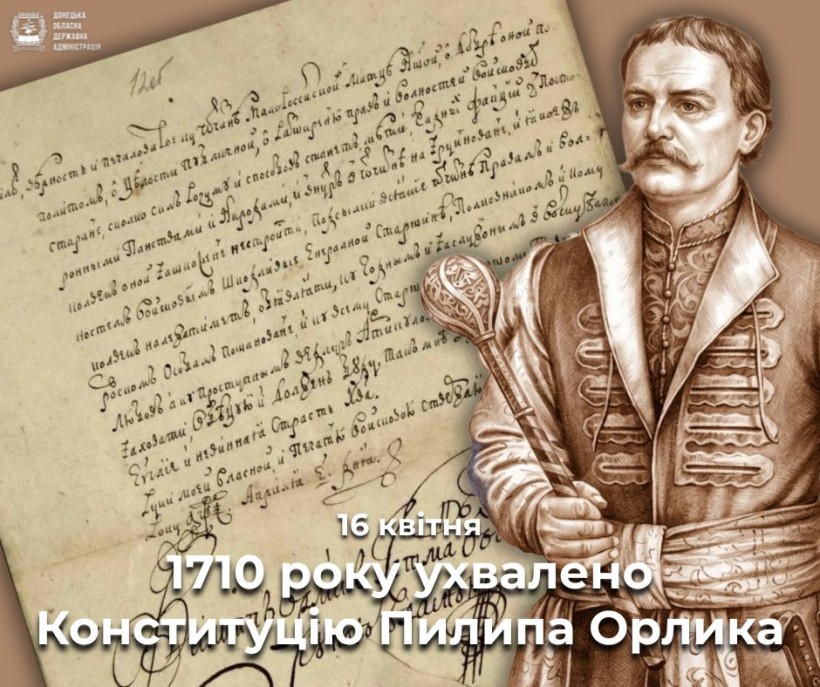
April 16 (5), 2026, marks the 316th anniversary of the adoption of Pylyp Orlyk’s Constitution. On this day in 1710, a constitution was signed for the first time in European history. At the time, this historic document was titled “Treaties and Resolutions on the Rights and Freedoms of the Zaporizhian Army.”
After the death of Ivan Mazepa, Pylyp Orlyk was elected hetman (in exile). The election of the hetman was accompanied by the signing of relevant agreements. The document referred to a sovereign republic, which nevertheless remained a protectorate of the Swedish king. The treaty was concluded in the city of Bendery between the newly elected hetman Pylyp Orlyk, the Cossack leadership, and the Cossacks of the Zaporizhian Army; later, this document came to be known as the “Constitution of Pylyp Orlyk” or the “Bendery Constitution.”
In the early 18th century, the document consisted of an introduction-preamble and 16 articles. It defined the relationship between the hetman and the Cossack leadership, the foundations of Ukraine’s state structure, and the rights and obligations of its estates in the event of the reconquest of its territories from the Muscovite Tsardom and the Polish-Lithuanian Commonwealth, and also proclaimed the reasons for the Zaporizhian Army’s transition to the protectorate of the Swedish Kingdom. The treaty was sealed by Pylyp Orlyk’s oath, his signature, and the state seal of the Zaporizhian Army, and was later ratified by King Charles XII of Sweden as the “protector of Ukraine.”
Modern historians believe that this document was the first to proclaim Ukrainian independence. This testifies to the Ukrainian people’s unceasing struggle for freedom from the times of Rus’, the Cossack State, and the Ukrainian People’s Republic to the present day.
“The Zaporizhian Army’s adoption of its own treaty provisions was truly a momentous event, as it attested to the political maturity of the Cossack state, which for the first time recognized its own identity and formally established the division of rights and responsibilities between the hetman and the ‘Cossack people.’ “The treaty became a unique historical document that laid the foundations of the Hetmanate’s democratic system on Cossack principles,” says historian Natalia Yakovenko.
Until recently, the document was known only through abridged copies published in Latin and Old Ukrainian. There was even doubt as to whether the original of this document existed.
In 2008, Ukrainian scholars discovered the original text of the “Constitution,” written in Old Ukrainian, in the collections of the Russian State Archive of Ancient Acts in Moscow. The original certificate from Charles XII confirming the election of Pylyp Orlyk as hetman is also preserved there. The authenticity of these documents is confirmed by the signatures of Hetman Pylyp Orlyk and Swedish King Charles XII.
For over 300 years, all references to this document were meticulously erased from history. However, in 2021, for the first time since the Constitution’s creation, the original was brought to Ukraine for a temporary exhibition as part of the celebrations marking the 30th anniversary of independence. Everyone had the opportunity to view the historic document at St. Sophia Cathedral in Kyiv.
The Constitution of Pylyp Orlyk has long deserved to be discussed not only as a monument of Ukrainian political and legal thought, but also as a monument of global political, legal, and philosophical thought, a gift to the civilized world from the Ukrainian cultural elite.