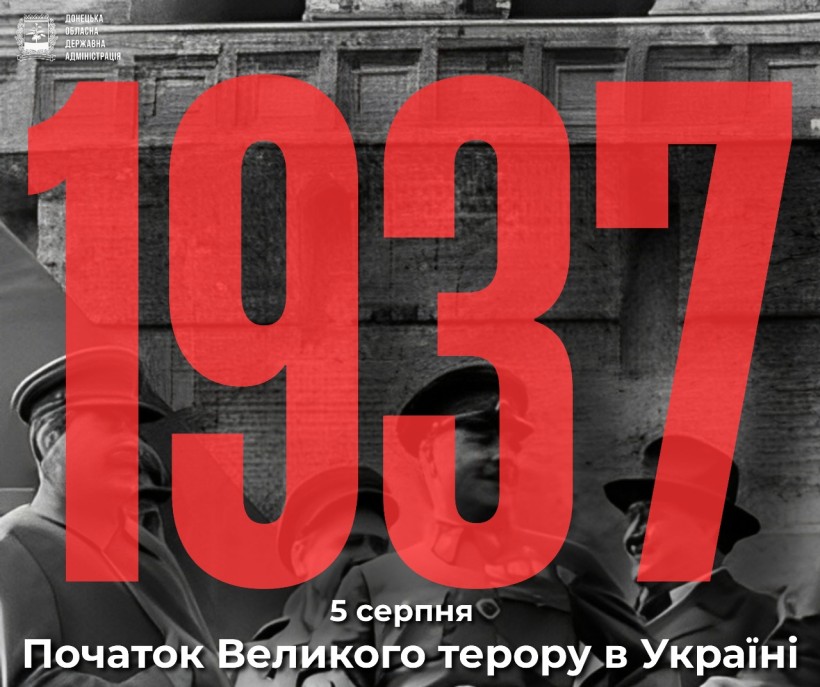
On August 5, 1937, the infamous "Great Terror" began, a mass repression aimed at destroying "enemies of the people" and strengthening Stalin's power.
A large-scale campaign of mass repression of citizens was launched in the USSR in 1937-1938 on the initiative of the USSR leadership and Joseph Stalin personally to eliminate real and potential political opponents, intimidate the population, and change the national and social structure of society. The consequences of the communist terror in Ukraine included the destruction of the political, artistic, and scientific elite, deformation of social ties, destruction of traditional value orientations, widespread social depression, and denationalization.
Officially, the beginning of the Great Terror was marked by the NKVD operational order of July 30, 1937, No. 00447 "On the Repression of Former Kulaks, Criminals, and Other Anti-Soviet Elements," approved by the Politburo of the Central Committee of the CPSU on July 31, 1937. However, the available NKVD documents (orders, correspondence, telegrams) show that mass repressions were prepared in advance, and the order only formalized them.
Order No. 00447 introduced limits (plans) for the punishment of citizens. Sentences under the first category meant "execution," and under the second category - imprisonment in the camps of the Gulag (Russian: Главное управление лагерей) of the NKVD of the USSR. While the initial limit for the Ukrainian SSR under category I was 26,150 people, in January 1938 it was increased to 83,122. The People's Commissars of Internal Affairs of the Ukrainian SSR, Israel Leplevsky and Oleksandr Uspensky, repeatedly appealed to Moscow for additional limits.
Even before Operational Order No. 00447 was issued, special attention was paid to the "cleansing" of party ranks and security agencies, which was to ensure the unconditional implementation of the center's repressive directives. Mass arrests began in June 1937. On July 10, 1937, the Politburo of the Central Committee of the CP(B)U sent instructions to the regions of the Ukrainian SSR to form an extrajudicial repressive body, the regional "troikas," created to simplify the conviction procedure. The troika usually consisted of the head of the regional NKVD (chairman), the regional prosecutor, and the first secretary of the regional or republican committee of the CPSU. The existence of troikas and other extrajudicial repressive bodies was completely contrary to Soviet legislation, including the Constitution.
The Great Terror is a repression that has spread to all regions and all segments of society without exception: from the country's top leadership to peasants and workers who are far from politics. It is a colossal falsification of charges. This is unprecedented planning of terrorist "special operations": No one could escape the "purge".
During the 15 months of the campaign, more than 1.7 million people were arrested on political charges in the USSR. Together with victims of deportations and convicted so-called "socially harmful elements," the number of repressed exceeded two million.
According to historians who in 1989 gained access to the statistical reports of the OGPU-NKVD-MIA-MGB from the Central State Archive of the USSR, 681,692 people were sentenced to death for political reasons in the Soviet Union in 1937-38, which was 85% of all citizens of the "great country" officially executed during the "Stalinist period."
The Great Terror of the thirties of the twentieth century did not break the Ukrainian people, their spirit and courage. the Russian Federation, on the other hand, inherited the worst Stalinist traditions, becoming a terrorist state that today poses a danger to the entire world.