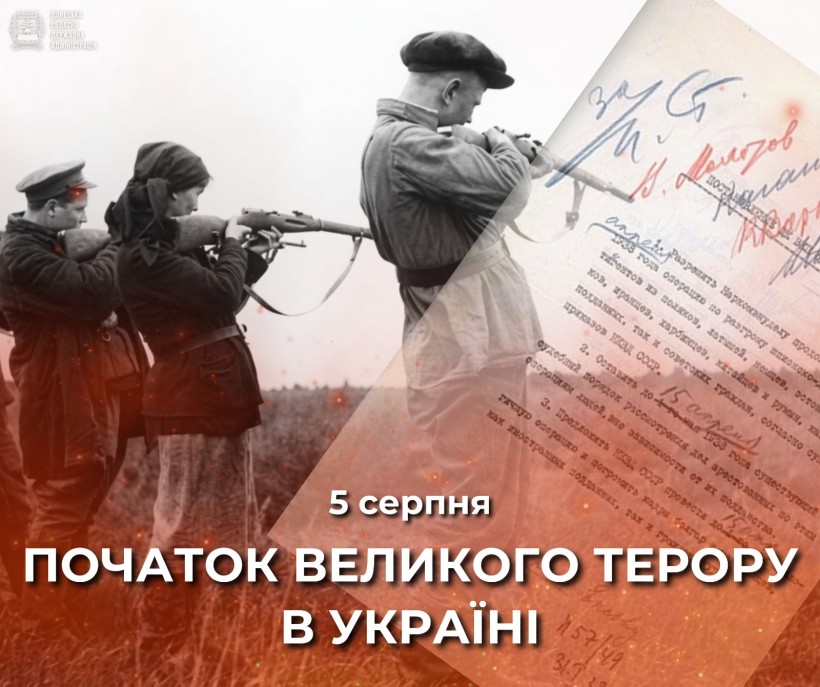
On August 5, 1937, the infamous Great Terror began, during which the communist authorities, through the state security agencies, imprisoned, tortured, executed, or sent more than 1.5 million people to the Gulag camps.
It was on this very day that, pursuant to Order No. 00447 of the NKVD of the USSR, Resolution P51/94 of the Politburo of the Central Committee of the All-Union Communist Party (Bolsheviks) dated July 2, 1937, “On Anti-Soviet Elements,” came into effect. This marked the beginning of the most massive “purge” of society in the entire Soviet era, targeting elements deemed “unsuitable for the construction of communism.”
The mechanism of repression itself had been set in motion much earlier, on September 26, 1936, when Nikolai Yezhov took the helm of the NKVD of the USSR. It is his name that is associated with the wave of the Great Terror initiated by Joseph Stalin. In fact, the new head arrived at the NKVD with a ready-made plan for repressive actions, primarily against figures opposed to Stalin.
In accordance with the aforementioned NKVD Order No. 00447, quotas (plans) for the punishment of citizens were established. Sentences under Category I meant “execution,” while those under Category II meant imprisonment in the camps of the NKVD’s GULAG (Russian: Glavnoe Upravlenie Lagerey).
In the Ukrainian SSR, which included the Moldavian Autonomous Republic, a total of 28,800 people were to be repressed.
Specifically, in the Kharkiv Oblast—2,000 (Category I) and 3,500 (Category II); in the Kyiv Oblast—2,000 and 3,500; in the Vinnytsia Oblast—1,000 and 3,000; in the Donetsk Oblast—1,000 and 3,000; 1,000 and 3,500 in the Odesa Oblast, 1,000 and 2,000 in the Dnipropetrovsk Oblast, 300 and 1,300 in the Chernihiv Oblast, and 200 and 500 in the Moldavian Autonomous Region.
“The operation,” the operational order continued, “is to begin on August 5, 1937, and be completed within four months.”
Starting in August, investigators routinely used brutal beatings during interrogations—extracting “confessions” from detainees that they had spied for foreign intelligence services (ranging from Polish to Japanese) or plotted an assassination attempt against Stalin. Or, after subjecting them to inhuman torture, they forced prisoners to sign interrogation protocols that were entirely fabricated by the investigators from start to finish—alleging that the suspect was a former gendarme, Socialist Revolutionary, Petliurist, White Guard member, kulak, Menshevik, Trotskyist, Borotbist, sectarian, or the like. There were countless variations; it all depended on the specific prisoner’s background and the investigator’s “creative” imagination.
And although Order No. 00447 ostensibly prohibited exceeding the approved “quotas,” this was quickly forgotten. After all, in a socialist country, exceeding any planned targets was considered a matter of honor. Thus, a fierce socialist competition broke out among the NKVD units—to see who could uncover and neutralize the most “enemies of the people.”
The People’s Commissars of Internal Affairs of the Ukrainian SSR, Izrail Leplevsky and Alexander Uspensky, repeatedly appealed to Moscow for additional quotas.
During the “Great Terror” in the Ukrainian SSR, historians estimate that 198,918 people were convicted, of whom about two-thirds were sentenced to execution. The rest were sent to prisons and camps, and only 0.3% of those arrested were released.
In the Sandarmokh area near the town of Medvezhyegorsk in Karelia alone, 1,111 people were executed over the course of several days from October 27 to November 4, 1937. Among them were 287 Ukrainians and people whose fates were linked to Ukraine. These included Les Kurbas, Mykola Kulish, Marko Voronyi, Mykola Zerov, Valerian Pidmohylny, and other prominent figures of the Ukrainian cultural renaissance of the 1920s.
The plan was to end the struggle against “hostile elements” within four months; however, the repressions lasted more than 15 months and were officially halted by a resolution of the Politburo of the Central Committee of the All-Union Communist Party (Bolsheviks) on November 15, 1938, although in reality they continued.
The Great Terror of the 1930s did not break the Ukrainian people, their spirit, or their courage. The Russian Federation, however, inherited the worst of Stalin’s traditions, became a terrorist state, and poses a danger to the entire world. Today, Ukrainian defenders continue to fight to defeat the aggressor once and for all and to prevent further attempts by the Russian Federation to destroy the Ukrainian people, our statehood, and to blackmail all of humanity.