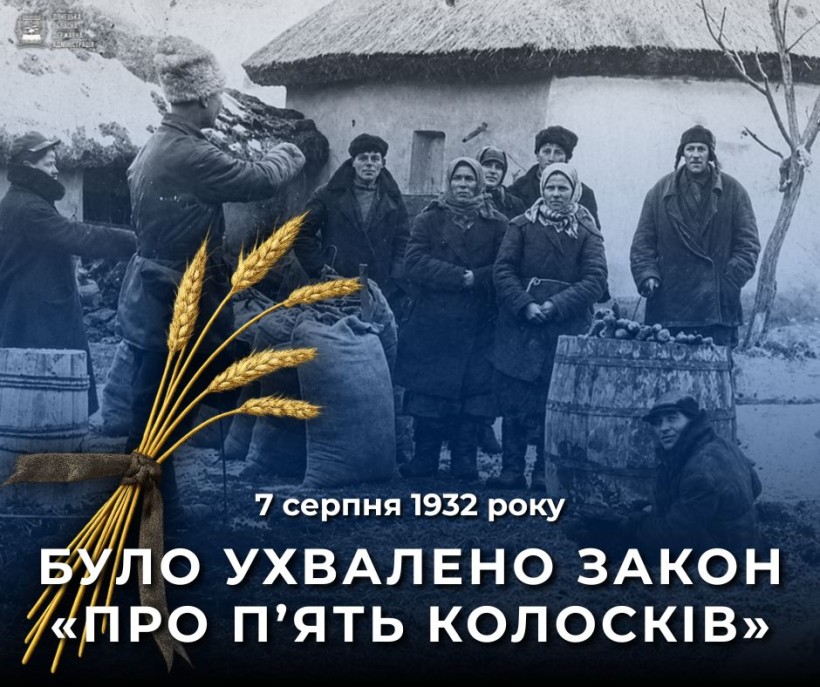
Any violent death is terrible: being shot, hanged, or strangled… It lasts seconds or minutes. But death by starvation drags on for weeks, even months. Death by starvation is a bloodless death. No blood is spilled; the blood gradually grows cold. Everyone was dying of starvation: men and women, old and young. Entire families and entire villages were dying out.
From the testimony of P. Avramenko, “The 33rd: Famine: The People’s Memorial Book”
August 7 marks the anniversary of the adoption of the “Law of the Five Ears of Grain”—as the Resolution “On the Protection of the Property of State Enterprises, Collective Farms, and Cooperatives and the Strengthening of Public (Socialist) Property” was popularly known—which was adopted on this very day in 1932. A sculpture of a girl greeting visitors to the Holodomor Museum holds the symbolic five ears of grain in her hands—as a reminder of this bloody law.
Dictator Joseph Stalin was the driving force behind the drafting and adoption of the resolution. On July 25, 1932, he personally proposed enacting a law “against the theft of cooperative and collective farm property and cargo in transit” and declared “…public property (cooperative, collective farm, and state) to be sacred and inviolable.”
According to the decree, cargo on rail and water transport, as well as the property of collective farms and cooperatives (crops in the fields, livestock, supplies, cooperative warehouses, and stores) were equated with state property. Theft of such property was punishable by the most severe penalty—execution with confiscation of property or, in the presence of “mitigating circumstances,” imprisonment for a term of no less than 10 years with confiscation. The decree stipulated that amnesty should not be granted to those convicted of such crimes.
Even a few ears of grain, a corn cob, or a few potatoes left in the field after the harvest were considered “theft.” At the same time, the USSR continued to export grain abroad (1.73 million metric tons in 1932, 1.68 million metric tons in 1933; in subsequent years, a higher figure was reached only in 1938). This would have been more than enough to feed all those starving. On top of that, piles of grain and potatoes gathered at railway stations for shipment to Russia often rotted in the open air.
The peak of the application of the punitive “Law of the Five Ears of Grain” occurred during the final stage of the grain requisition campaign from late November 1932 to January 1933. It was during this period, having exhausted the so-called “visible grain reserves,” that the authorities began to fulfill the procurement quota by confiscating from the peasants “stolen, illegally distributed, and hidden grain.” The policy was as follows: if you failed to meet the grain procurement quota and they found even a single edible item in your possession, it was assumed that you had stolen and hidden it. Secretly grinding grain was also considered a criminal offense and fell under the decree’s provisions. As a result, peasants’ millstones were confiscated or smashed.
The “Law of the Five Ears of Grain” became one of the key documents of the Holodomor, as it deprived Ukrainians of their right to survival. Under the conditions of the time, it effectively prohibited people from disposing of their own food. Ukrainians found themselves in a deadly trap: the unrealistic grain delivery quotas (or, more simply, plans to confiscate grain) doomed peasants to starvation. Any attempts to save themselves and hide food were punishable by the confiscation of all edible supplies (for failure to meet grain delivery quotas) or execution.
According to information published in 1988 by the newspaper *Pravda*, in less than five months after the adoption of the “Law on Five Ears of Grain,” 54,645 people were convicted under its provisions. Of these, 2,110 were sentenced to death. Even children who tried to find any food at all were punished. The decree remained in effect until 1947, when it was replaced by the Decree of the Presidium of the Supreme Soviet of the USSR “On Criminal Liability for Theft of State and Public Property,” which established differentiated liability—punishments ranged from 5 to 25 years depending on the severity of the crime.
History is not merely repeating itself—today it is coming to life in its bloodiest details. Russia is now attempting to achieve the very same geopolitical goals that the Kremlin pursued in 1932 through repressive legislation. Russia’s full-scale invasion has shown that the “Law of the Five Ears of Grain” is no longer just a page in a textbook: modern Moscow has returned to the same time-tested tactics of terror, plunder, and the use of food as a weapon. Back then, the target of punitive raids was a few ears of grain in the pocket of a starving Ukrainian peasant; today, millions of metric tons of Ukrainian grain in ports and grain elevators have become the target of Russian missiles. The destruction of agricultural infrastructure, fields scorched by artillery, and the large-scale looting of crops in the occupied territories prove that Russia has once again adopted the genocidal tools of a century ago in its current war against Ukraine. The famine terror of 1932–1933 and the Russian Federation’s current genocidal war share a common root—Moscow’s desire to permanently eradicate Ukrainian identity and resistance.