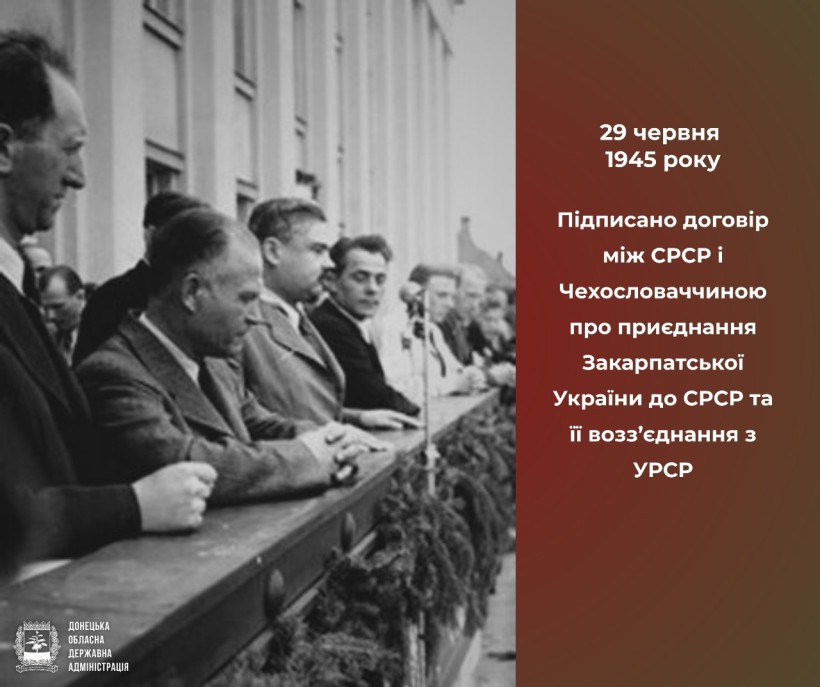
In 1945, the reunification of Ukrainian lands within the USSR took place. This was the result of a treaty between the USSR and the Czechoslovak Republic, signed on June 29, 1945, in Moscow.
The accession of the lands of Transcarpathian Ukraine to the Ukrainian SSR was preceded by a series of events. Thus, on October 28, 1944, the Red Army, during the East Carpathian offensive operation, with the forces of the 4th Ukrainian Front — the 18th Army and the 17th Guards Corps — seized the entire territory of Subcarpathian Rus. During the offensive, Soviet troops had to overcome a well-fortified Hungarian defense system ("Arpad Line").
After the expulsion of the German occupiers and their Hungarian allies, the Soviet military administration did not restore the activities of the pre-war Czechoslovak authorities, citing that Transcarpathia remained a front-line zone. On November 26, 1944, in Mukachevo, in the presence of representatives of the repressive bodies of the USSR, the First Congress of People's Committees of Transcarpathian Ukraine took place, which adopted a Manifesto prepared in Moscow on the unification of Transcarpathia with Soviet Ukraine and elected the highest governing body — the People's Council of Transcarpathian Ukraine. Although it was attended by 663 delegates: 178 workers, 258 peasants, 172 representatives of the intelligentsia, 55 merchants and craftsmen, the communists predominated in number. The People's Council of Transcarpathian Ukraine was headed by Ivan Turyanytsia, with Petro Lintur and Petro Sova as his deputies. The Congress set the task for the People's Council of Transcarpathian Ukraine to manage the political and economic life of the region and to implement the will of its population for unification with the Ukrainian SSR.
On the second day after the Congress, the People's Council of Transcarpathian Ukraine formed a government consisting of a presidium and authorized representatives. On December 5, 1944, it issued a decree "On the termination of relations with the authorized representative of the government of the Czechoslovak Republic," and also made a decision on the transfer of ownership rights to state property from the Czechoslovak Republic and the Kingdom of Hungary to Transcarpathian Ukraine.
According to the decree of the People's Council of Transcarpathian Ukraine dated January 9, 1945, all power in Transcarpathia belonged to the people, and people's power was exercised through freely elected representative bodies — the People's Council of Transcarpathian Ukraine at the center and people's committees at the local level. The People's Council of Transcarpathian Ukraine had a wide range of competencies: law-making, leadership of economic, political, and cultural life, and the work of law enforcement agencies in the region. The head of the People's Council represented Transcarpathian Ukraine and the People's Council at the international level, exercised the highest executive and administrative power, convened and chaired meetings of the People's Council, signed its resolutions, appointed heads and officials of state institutions upon the proposal of the authorized representatives of the People's Council, and approved district and city judges. On January 12, 1945, the People's Council issued a decree on the anthem and state flag.
Ultimately, on June 29, 1945, in Moscow, a Treaty was signed between the Union of Soviet Socialist Republics and the Czechoslovak Republic regarding Transcarpathian Ukraine, according to which "Transcarpathian Ukraine (which, according to the Czechoslovak Constitution, is called Subcarpathian Rus), which, based on the Treaty of September 10, 1919, concluded in Saint-Germain-en-Laye, entered as an autonomous unit within the Czechoslovak Republic, is reunified, in accordance with the desire expressed by the population of Transcarpathian Ukraine, and based on the friendly agreement of both High Contracting Parties, with its ancient homeland — Ukraine and is included in the composition of the Ukrainian Soviet Socialist Republic." It should be noted that representatives of Transcarpathian Ukraine were not invited to the signing ceremony of the interstate treaty.
80 years have passed since the day the treaty between the USSR and Czechoslovakia was signed in Moscow regarding the transfer of Transcarpathian Ukraine to the Ukrainian SSR. It was signed on behalf of the USSR by V. Molotov, and on behalf of the Czechoslovak Republic by Z. Firlinger and V. Clementis.
By the decree of the Presidium of the Supreme Soviet of the USSR dated January 22, 1946, the republic of Transcarpathian Ukraine was liquidated and transformed into an oblast of the Ukrainian SSR with its center in Uzhhorod. No representative of Transcarpathian Ukraine was present in Moscow when this decision was made. On January 25, 1946, by the decree of the Presidium of the Supreme Soviet of the Ukrainian SSR, the jurisdiction of the Ukrainian SSR was introduced in the Transcarpathian oblast.
The completion of the process of reunification of all Ukrainian lands into a single state marked the end of an entire era of struggle for the unity of the Ukrainian people and became a fateful act of extraordinary importance in the history of Ukraine.
Despite the fact that the reunification of Transcarpathian Ukraine with Soviet Ukraine took place under the specific conditions of World War II and the prevailing situation of the Soviet Union upon the entry of its troops into Eastern Europe, and was accompanied by rampant Soviet propaganda and the persecution of the leaders of Carpathian Ukraine, who laid the foundations for this unification, it is worth recognizing that our predecessors successfully seized the historical moment. It is no coincidence that our compatriot Mykhailo Mondych emphasized regarding the reunification of Transcarpathia with Soviet Ukraine that if the opportunity provided by history was missed in 1944–1945, such reunification could only occur in a thousand years.