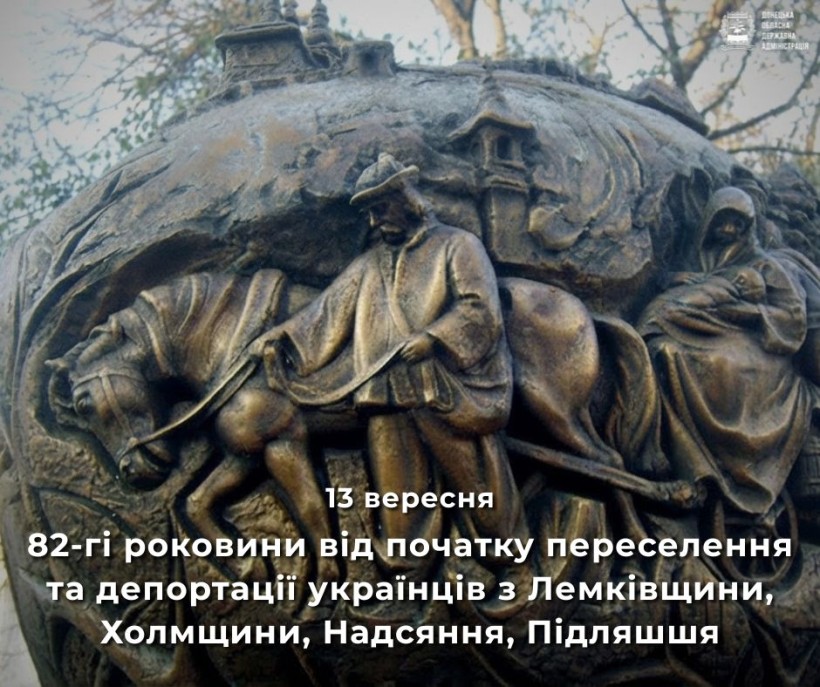
In 2018, the Verkhovna Rada of Ukraine designated the second Sunday in September as the official day of remembrance for the forced deportations of Ukrainians in 1944–1951. This year, that day falls on September 13.
The mass resettlement and deportation from Lemkivshchyna, Kholmshchyna, Nadsyannya, and Pidlyashshya took place between 1944 and 1951 as a result of agreements between the USSR and Poland. The first phase took place in 1944–1946, when approximately 482,000 Ukrainians were resettled. Then, in 1947, as part of Operation Vistula, another approximately 150,000 people were deported. In total, according to various sources, approximately 700,000 Ukrainians were resettled from these regions to the Ukrainian SSR.
The deportation of Ukrainians from these territories was driven by political and ethnic motives aimed at creating a mono-ethnic Polish state and resolving the “Ukrainian question.” It was accompanied by violence, confiscation of property, restrictions on rights, and terror.
One of the outcomes of World War II was the establishment of new state borders in Europe, particularly between the USSR and Poland. To establish the Soviet-Polish border and resolve long-standing disputes over contested territories between Ukrainians and Poles, on September 9, 1944, in Lublin, the chairmen of the Council of People’s Commissars of the Ukrainian SSR, Nikita Khrushchev, and the Polish Committee of National Liberation, Edward Osubka -Morawski, signed an agreement on a “mutual exchange of populations”: Ukrainians from Polish territory to the Ukrainian SSR and Poles from Ukrainian territory to Poland.
All citizens of Ukrainian nationality from the districts of Chełm, Hrubieszów, Tomaszów, Krasnystaw, Wołodawa, and other counties in the Lublin and Rzeszów Voivodeships—and later from the Kraków Voivodeship—were subject to relocation to the USSR. The resettlement was supposed to be voluntary, but it turned into forced deportations accompanied by repression, confiscation of property, and restrictions on people’s political, social, economic, and cultural rights.
The basis for resettlement was lists of individuals who had expressed a desire to leave Poland, renounce their Polish citizenship, and obtain a passport of the Ukrainian SSR. Moreover, this expression of intent could be either written or verbal. This created ample opportunities for abuse. The agreement did not specify criteria for determining a person’s nationality. Ultimately, the primary basis for deportation was the identification card issued by the Nazi occupation authorities (Kennkarte), which contained information on religion and nationality.
Under this agreement, between 1944 and 1946, more than 482,000 Ukrainians were forcibly resettled to the Ukrainian SSR. In Soviet Ukraine, they were resettled across 17 regions—from Galicia to the Black Sea coast, Slobozhanshchyna, and Donetsk Oblast.
A total of 10,037 Lemkos and Boikos—members of an ethnographic group of Ukrainians—were resettled to the territory of the Stalino (Donetsk) Oblast. Specifically, Boikos from the villages of Liskovate and Korosno in the Khyrivsky District of the Drohobych Oblast were resettled to the villages of Zvanivka, Rozdolivka, and Verkhnokamyanske in what is now the Bakhmut District. Residents of the village of Chorna in the Nyzhno-Ustrytskyi District were resettled to the Telmanivsky (now Kalmiusky) District; specifically, 514 people were resettled to the settlement of Telmanove (now Boikivske), 282 to the village of Michurine, to the village of Starolaspa—299, and to the former Oleksandrivka District, specifically the village of Krynytsi—several hundred.
At the same time, nearly 790,000 Poles and Jews were resettled from the western regions of Soviet Ukraine to Poland.
The deportation of Ukrainians continued with “Operation Vistula,” carried out by the Polish communist regime. In 1947, the Polish authorities deported those Ukrainians who refused to leave for the USSR to the north and west of Poland. In just a few months, nearly 150,000 people were forcibly resettled.
Several tens of thousands more Ukrainians were deprived of their ancestral homes during the border exchanges between the USSR and Poland in 1948 and 1951.
The resettled Ukrainians faced material and emotional hardships. In their new locations, they had to adapt to new economic conditions. For example, former residents of the Carpathian Foothills and the Carpathian Mountains—with a traditional way of life shaped by mountainous, forested terrain—found themselves in the southern regions of Ukraine and had to adjust to a steppe climate and an agrarian culture.
Virtually all those who arrived in the Ukrainian SSR faced a housing crisis. The plan was to house resettlers in the southern regions in former German colonies. However, by the time of the resettlement, some colonies had been burned down, while others had been taken over for subsistence farming. Some of the houses in the colonies were occupied by local collective farm members and various newcomers who had lost their homes during the war. Consequently, the only vacant premises left were those unsuitable for habitation.
Those who ended up in the western regions were housed in homes abandoned by Poles. But even here, progress was far too slow. The only favorable factor for adaptation in this region by the end of 1947 was the opportunity to run an individual farm or work on wealthy estates.
Housing shortages were not the only hardship faced by the resettlers. They were subjected to arbitrary treatment and lawlessness. Numerous examples of this are documented. For instance, in 1945, there were cases where resettlers were handed notices regarding mandatory state deliveries as early as the second day after their arrival at their new location.
Mass political indoctrination was carried out among the deportees for the purpose of “Soviet re-education.” Those dissatisfied with the communist regime were arrested and tried as “nationalist elements.”
Overall, forced resettlement led to the destruction of the historical, material, moral, and cultural values of Lemkivshchyna, Western Boikivshchyna, Nadsyannya, Kholmshchyna, and Podlasie, and threatened the annihilation of entire ethnographic groups of the Ukrainian people.