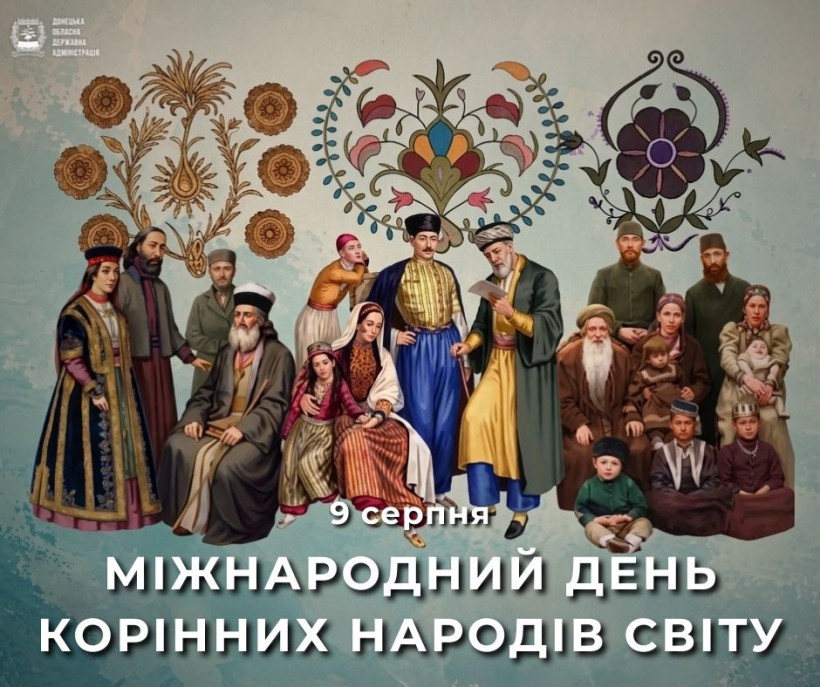
On August 9, Ukraine, together with the entire international community, celebrates the International Day of the World’s Indigenous Peoples, recognizing their value, cultural diversity, and forms of social organization.
An indigenous people is not the same as a national minority. Ukraine is home to quite a few national minorities but only a few indigenous peoples. To be considered an indigenous people, an ethnic community must have formed as such specifically within the territory of Ukraine, possess a distinct language and culture, and not have its own state outside of Ukraine.
Alongside Ukrainians, the indigenous peoples of Ukraine include the Crimean Tatars, the Karaites, and the Krymchaks. Their historical homeland is Crimea. International law and Ukrainian legislation protect indigenous peoples. This primarily concerns the preservation and development of their own languages, cultures, and traditions, as well as protection from oppression, forced assimilation, or genocide.
But in their historical homeland, in occupied Crimea, members of indigenous peoples—above all, the Crimean Tatars—face the opposite reality. Therefore, August 9 is yet another opportunity to remind the world that “Russia has turned Crimea into one big prison,” as Akhtem Chiygoz, deputy chairman of the Mejlis of the Crimean Tatar People, puts it.
The assimilation of indigenous peoples is a long-standing tactic of the Russian Empire, one that the modern Russian regime continues to employ, both within the Russian Federation itself and in the occupied territories. Those who resist assimilation or refuse to cooperate with the occupying authorities are persecuted.
According to the Crimean Human Rights Group, in October 2020 alone, 70 Crimean Tatars were implicated in the fabricated “Hizb ut-Tahrir case,” also known as the “Crimean Muslims case.” The case itself was divided into 11 groups, as the Crimean Tatars were tried by an illegal court in various cities: Simferopol, Sevastopol, Bakhchysarai, Yalta, Krasnogvardeisky, Belogorsk, and Alushta.
And with the start of Russia’s full-scale invasion of Ukraine, according to the civil society organization “Crimea SOS,” the persecution of Crimean Tatars began on the basis of their alleged participation in the Crimean Tatar unit of the Ukrainian Defense Forces—the Noman Chelebidzhihan Battalion. According to Yevgeny Yaroshenko, an analyst with the civil society organization, while the so-called “Hizb ut-Tahrir case” required detaining at least practicing Muslims, any Crimean Tatar who is disloyal to the occupying administration can be accused of involvement with the Noman Chelebidzhihan Battalion.
The protection of the rights of indigenous peoples is a hallmark of a stable democracy and a developed state. The adoption on July 1, 2021, of the Law “On the Indigenous Peoples of Ukraine” demonstrated the priority Ukraine places on issues related to the formation and implementation of a comprehensive state policy of ethno-national unity, the harmonization of interethnic relations, and the protection of the rights of indigenous peoples.
Ukraine, which protects the rights of its indigenous peoples, is fundamentally different from Russia, which, despite comprising dozens of indigenous peoples, directs its efforts toward their assimilation, systematically destroying their identities, languages, and cultures. It even carries out physical extermination, using their male population as cannon fodder in its own military adventures.
Today, the International Day of the World’s Indigenous Peoples is intended to draw the international community’s attention to the protection of indigenous peoples’ rights, the preservation of their distinctiveness, and the prevention of their forced assimilation and the deprivation of their lands, territories, or resources.