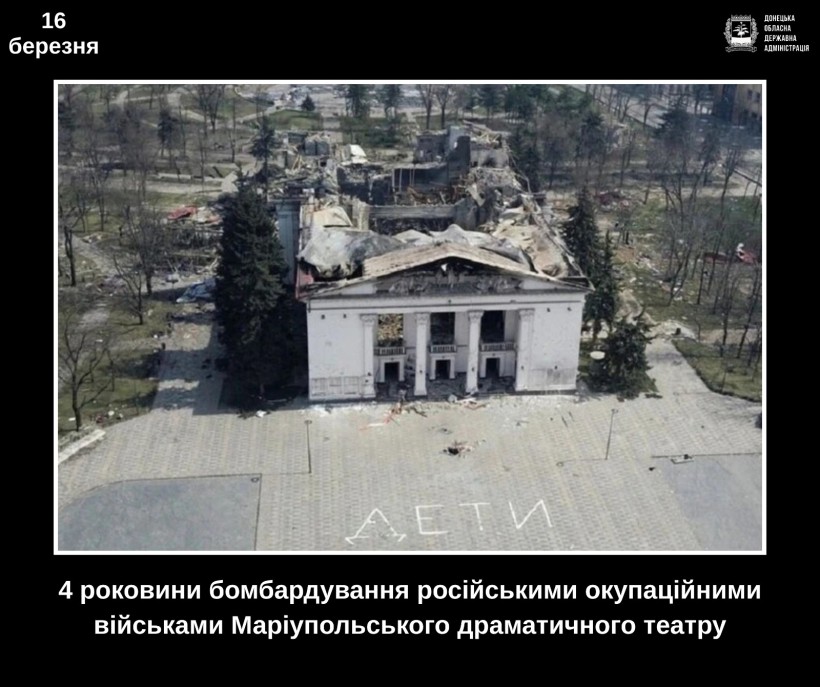
The Mariupol Drama Theater is one of the most famous cultural landmarks in the Azov region and has long been the center of theatrical life in the Donetsk region. The theater building was constructed between 1956 and 1960 based on a design by architects Oleksandra Krylova and Oleg Malyshenko. The grand opening took place on November 2, 1960. For decades, the theater was an important cultural venue in the city: it hosted performances, festivals, creative gatherings, and other artistic events that brought together Mariupol residents and visitors.
With the start of the Russian Federation’s full-scale invasion in February 2022, the theater became a refuge for civilians. During the constant shelling of Mariupol, hundreds of people took shelter in its premises—mostly women, children, and the elderly who had lost their homes or were unable to evacuate. According to eyewitness estimates, there were about a thousand people in the theater at the time.
On March 16, 2022, Russian aircraft dropped two powerful bombs on the drama theater building. The strike hit the central part of the structure and virtually destroyed it from the inside. The explosion caused massive destruction, trapping people who had been hiding there under the rubble.
What made this crime particularly cynical was that the word “CHILDREN” was written in large letters in front of and behind the building, clearly visible from the air and on satellite images. In this way, the residents were trying to signal that only civilians were inside the building.
The exact number of fatalities remains unknown. The bombing of the Mariupol Drama Theater became one of the most notorious war crimes committed by the Russian army against the civilian population during Ukraine’s War of Independence and drew widespread international condemnation.
Russia denies its crime and, having occupied Mariupol, did everything to “cover its tracks”…
For Ukrainians, the Mariupol Drama Theater has become not only a symbol of the city’s cultural life but also a symbol of tragedy, pain, and remembrance of the hundreds of civilians who died during the siege of Mariupol. Despite the building’s destruction, the memory of this event remains an important part of Ukraine’s modern history and a reminder to the world of the cost of Russian aggression.