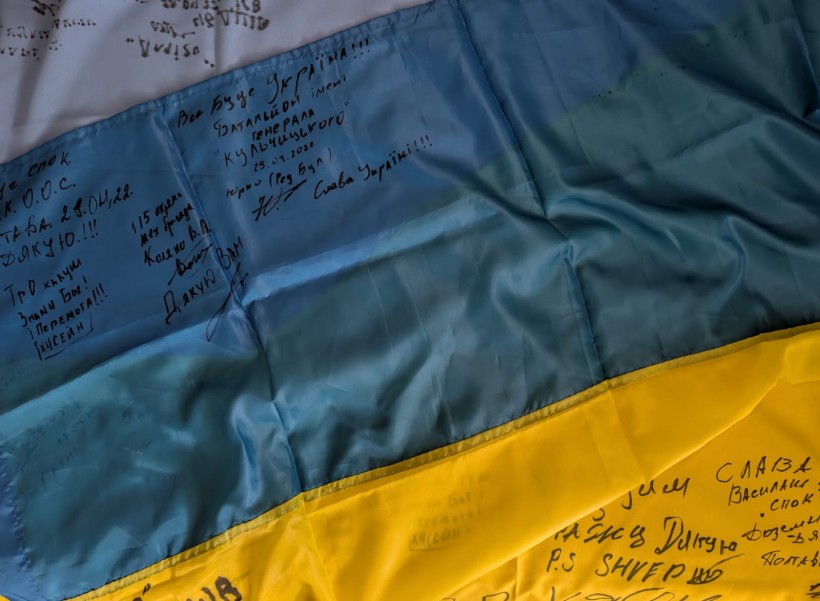
Every year on August 23, since 2004, Ukraine has honored one of its three key state symbols—the blue-and-yellow flag. It is also a national symbol—a symbol of our Ukrainian identity and a symbol of the struggle for freedom.
Today, the flag is more than just a marker of “friend or foe,” for it serves as a talisman, accompanying our soldiers on their shoulder patches, in their backpacks, and at their posts. They carefully sign it with their call signs as a memento for their comrades and volunteers. It flies over the free and liberated cities of Ukraine. And Ukrainians in the occupied territories are waiting for the day when it will once again fly proudly in their cities, towns, and villages. It is a sacred symbol, a relic that is cherished and will be passed down through the generations, for every yellow-and-blue flag has acquired its own unique history over the years of Ukraine’s War for Independence. On Ukraine’s National Flag Day, we invite you to reflect on a few of these stories.
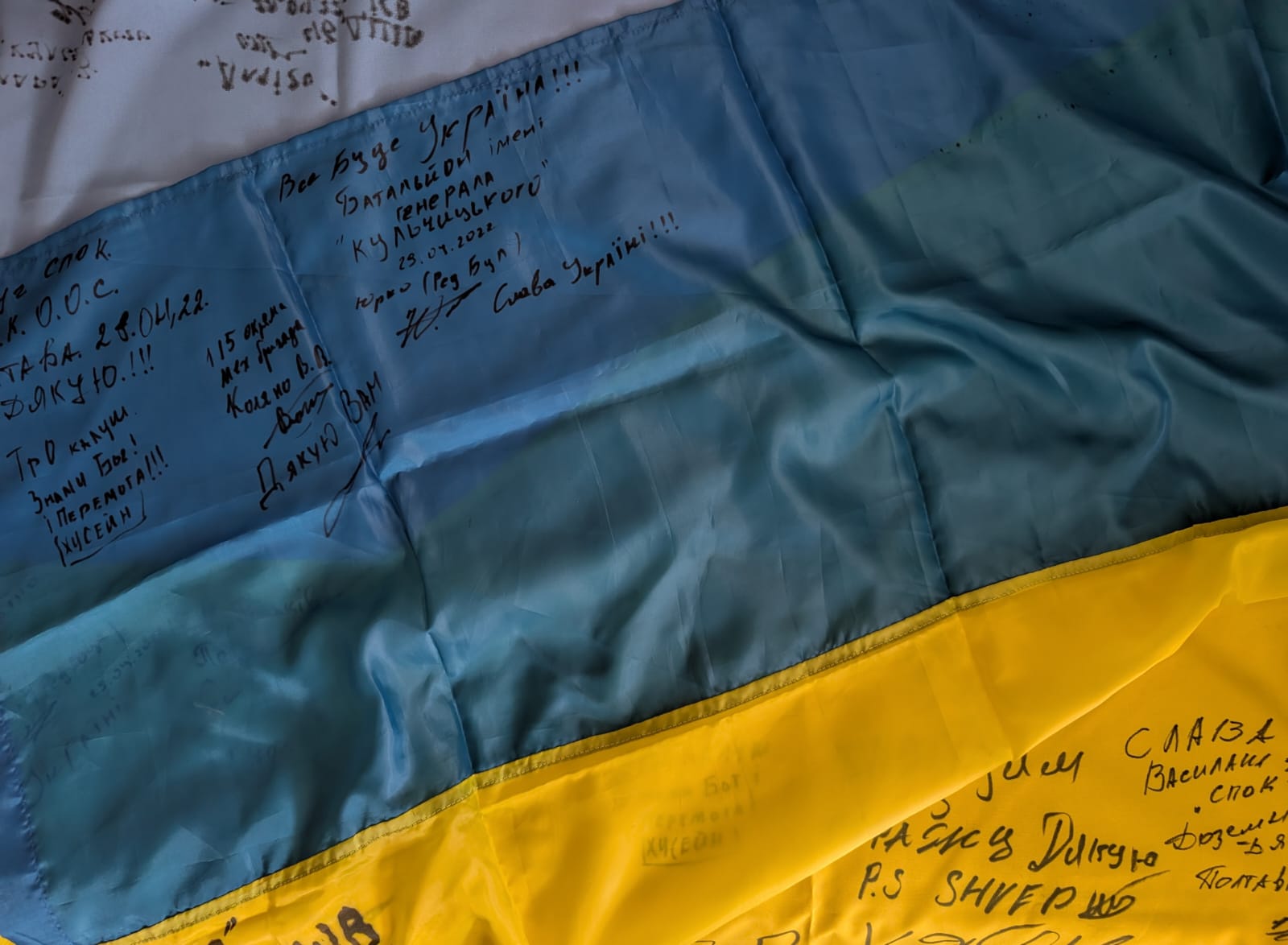
Alevtina Shevtsova: “This will be our family heirloom and a treasure that I will pass on to my descendants.”
Alevtina Shevtsova is a journalist, host, and curator of cultural projects about Mariupol. In 2022, she carried a blue-and-yellow flag in her backpack past 17 checkpoints.
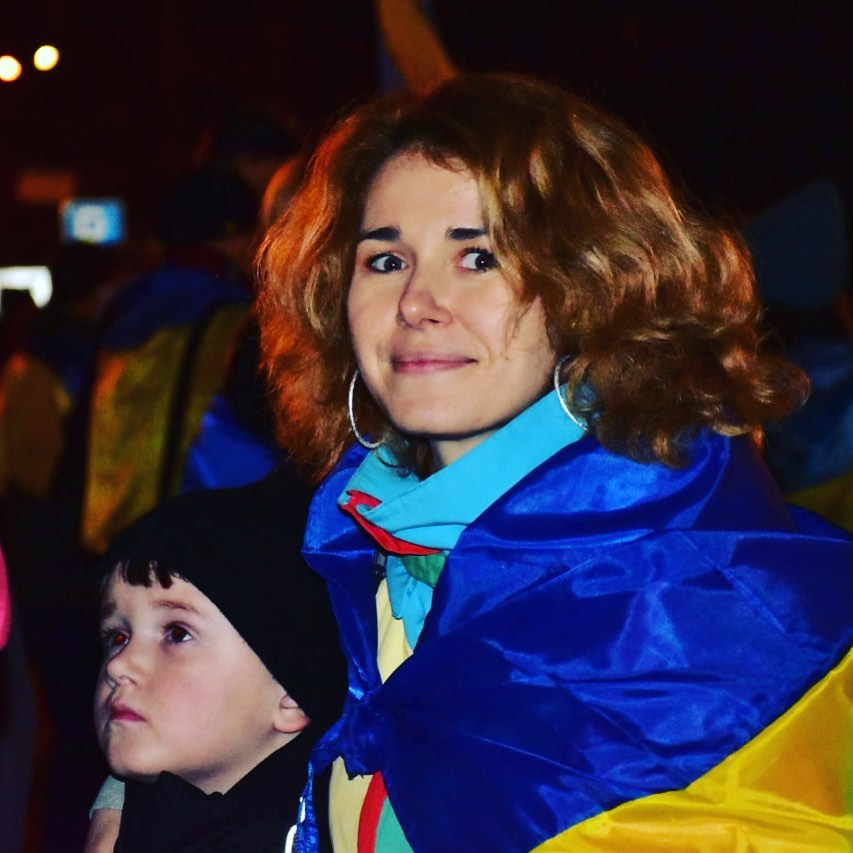
Alevtina Shevtsova with her son during a rally on February 22, 2022, in Mariupol. Photo from A. Shevtsova’s archive
“I found the Ukrainian national flag inside a store, in the basement of which we were hiding during the siege of Mariupol. People were looking for batteries there to get a little light. On one of the shelves, I saw a blue-and-yellow flag. I put the flag in my backpack.
On March 16, a Russian aerial bomb dealt a devastating blow to the Mariupol Drama Theater, and that’s when we decided to leave the city on foot. The Ukrainian flag was among our belongings. I felt no fear as I passed through nearly two dozen enemy checkpoints. My emotions had been left behind in the devastated city of Mariupol. However, I knew that if the occupiers found the Ukrainian national flag in my backpack, there could be serious consequences. At the same time, I understood that I had no moral right to leave it behind under occupation.
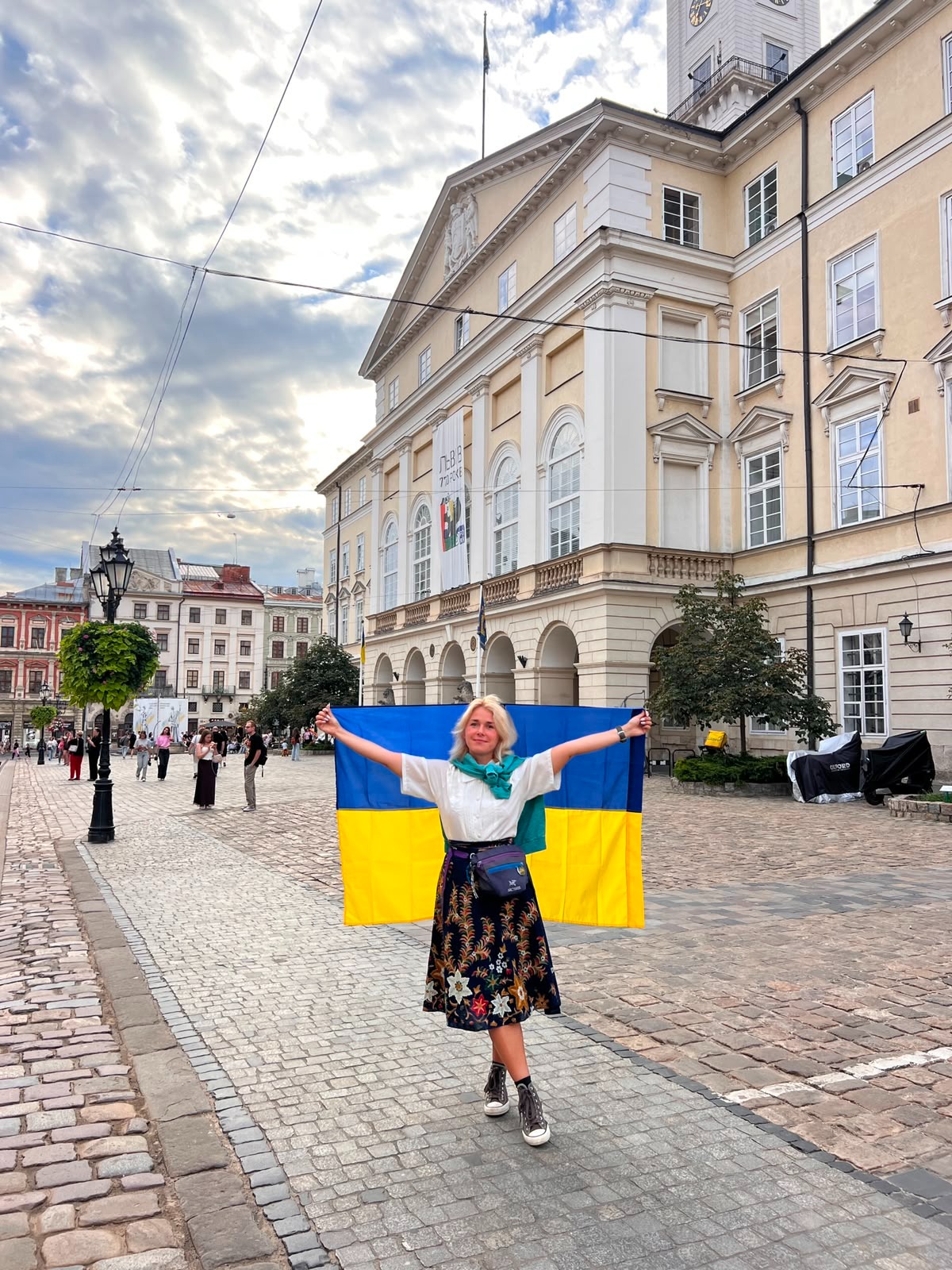
Alevtina Shevtsova with the Ukrainian flag she brought out of the country.
Photo from A. Shevtsova’s archive
Over time, a family tradition developed in our family connected with the rescued flag. Since our friends are scattered all over the world, we came up with the idea of having the people we meet—as well as our acquaintances and relatives—sign this flag.
I tell my son the story of this flag. It will be our family heirloom and a treasure that I will pass on to my descendants.
My dream is to live to see the liberation of my hometown—so that I can return, whenever that may be, and walk through a free Ukrainian city, its streets wrapped in a flag the color of the sky and wheat.”
Natalia Vybornova: “Only now do I fully understand why, back then, amid the haphazardly gathered belongings, it was so important for me to pack this flag into my suitcase.”
Natalia Vybornova is the head of the Department of Organizational Work and Human Resources at the Mangush Town Military Administration. In 2022, she brought Ukrainian flags and embroidered shirts out of occupied Mariupol.
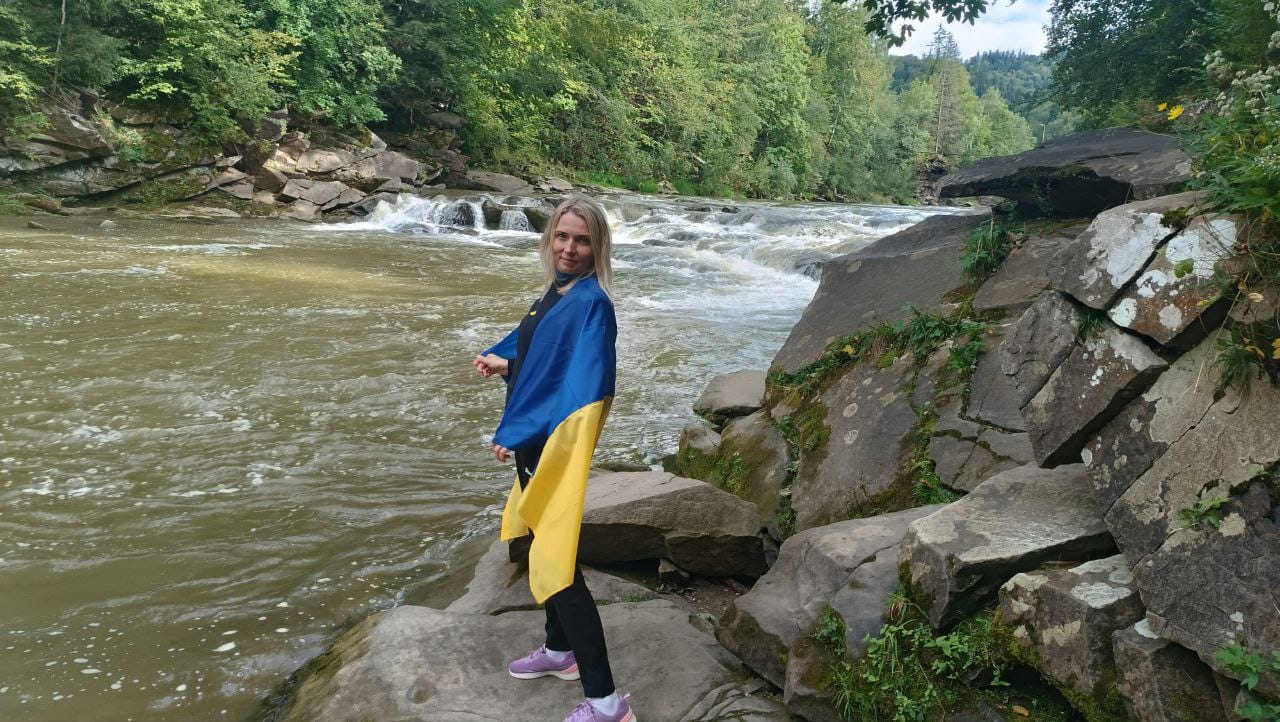
Natalia Vybornova, photo from N. Vybornova’s archive
“When we were packing the things we could take with us from Mariupol, everything was very chaotic. I packed a lot of things into my suitcases that, as it turned out later, I still haven’t needed. But when I opened the drawer where our embroidered shirts and Ukrainian flags were kept, it never even crossed my mind to leave them behind.
I can’t explain why. It was just very important to me at that moment to take them with me.
I packed a large Ukrainian flag, small car flags, and our embroidered shirts into the suitcase. There were also my son’s medals, which he’d won at wushu competitions. They were all on blue-and-yellow ribbons.
I didn’t even try to hide any of it in any special way. I just put it all in the suitcase. At the time, I didn’t think at all about whether it was safe or not. Probably because of all the chaos around me and in my head, the realization of the danger just didn’t sink in.
At first, we tried to leave via Vasylivka, but we couldn’t. My parents took me to Novoazovsk, and from there we had to travel through Russia. So our flags traveled that route with me.
In Novoazovsk, they didn’t check our belongings. But at the Russian-Latvian border, they scanned my suitcases and saw the medals. The woman conducting the inspection asked, “What kind of ribbons are these medals on?”
I replied, “The ribbons of the country where he earned them.”
She looked at me—and that’s when it finally dawned on me: if they asked me to open my suitcase now, they wouldn’t just see blue-and-yellow ribbons on the medals. Inside were Ukrainian flags and embroidered shirts.
It was 3:00 a.m. And for the first time on this entire journey, I was truly gripped by fear. But they didn’t open the suitcase.
We crossed the border on foot. And once I’d come out with the suitcases, I practically ran toward Latvia. I wanted only one thing—to get as quickly as possible to the place where no one would ever ask me to turn back.
So those flags left the occupied territory with me and traveled this entire journey.
We still keep the large Ukrainian flag to this day. My son’s medals, too. We wear embroidered shirts. And now the flag travels around Ukraine with my son: when he climbs our mountains, he takes it with him and marks the places he’s visited on it.
I suppose it’s only now that I fully understand why, back then, amid the haphazardly gathered belongings, it was so important for me to pack that flag in my suitcase.
Because many of the things I took with me back then turned out to be unnecessary. But that flag—it’s still with us today.”
Lyudmila Huseynova: “It will be the greatest reward of my life—to see this flag again.”
Lyudmila Huseynova is an activist, public figure, human rights defender, and former civilian hostage who spent more than three years in enemy captivity for her pro-Ukrainian stance. During the occupation of Novoazovsk, she lived in her hometown. She actively helped volunteers from Mariupol. They, in turn, passed on money and provisions to the soldiers defending Shyrokyne. The grateful soldiers gave Lyudmila Huseynova the most precious thing they had—the blue-and-yellow flag.
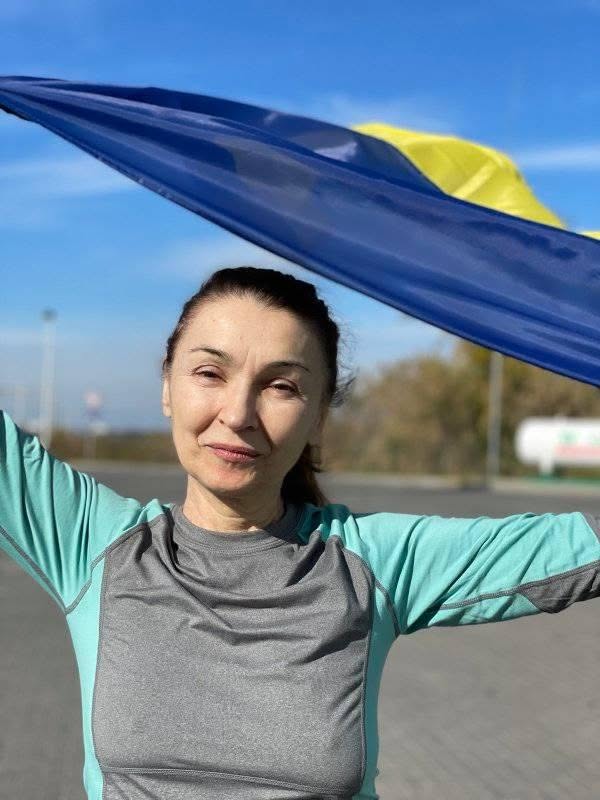
Lyudmila Huseynova, photo from L. Huseynova’s archive
“The story of my flag is unusual. I brought it from Mariupol to Novoazovsk, which at the time was a temporarily occupied city.
In Mariupol, soldiers from the “Lviv” battalion, who were leaving for rotation, gave me this flag. They signed it, leaving their autographs on it, and also wrote in large letters: ‘To the patriots of Novoazovsk.’
I managed to hide the flag and actually carried it on my person through the checkpoints into the occupied territory, to my occupied city. I showed it to my friends. It was during some kind of holiday—I no longer remember if it was Independence Day or another important date. But I remember how moving it was. My friends were crying because they felt the same way I did.
Later, I took a photo of the flag and hid the flag itself safely. But the photo began to spread among people.
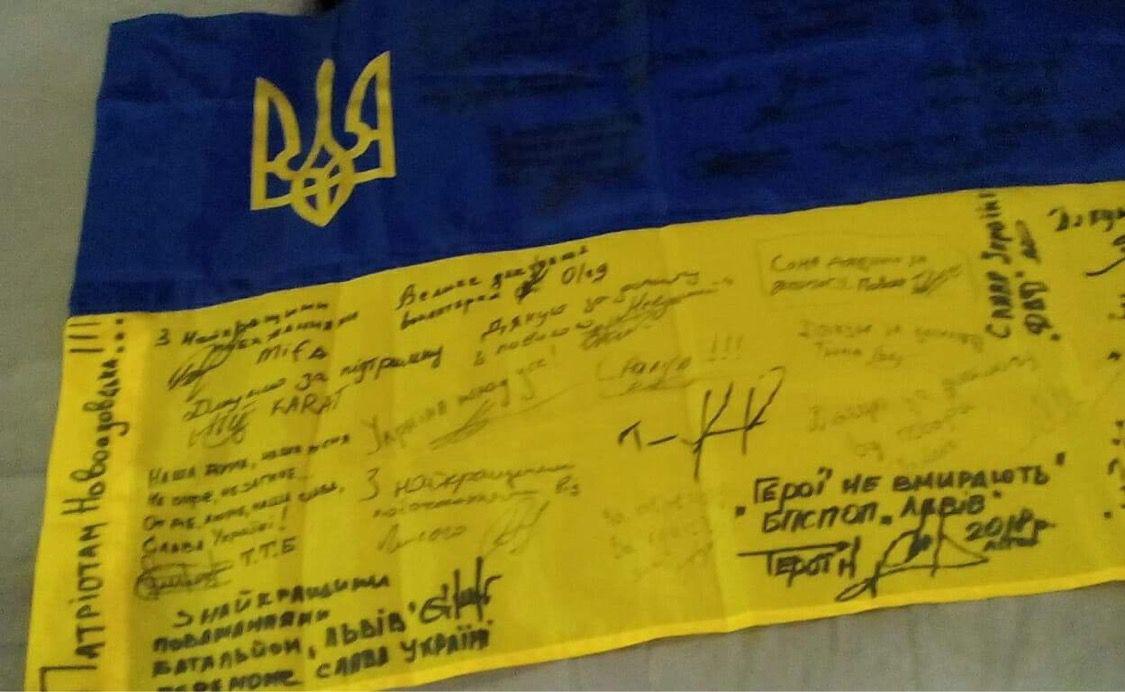
A flag signed for Lyudmila Huseynova by soldiers of the “Lviv” Battalion; photo by L. Huseynova
During a search, the occupiers found a photo of the flag. They demanded that I show them where it was hidden. That was probably the last straw that led to my arrest.
But I didn’t reveal the hiding place. They searched for it, beat me, and demanded that I tell them where the flag was, but I didn’t point out the hiding place.
And that flag is still hidden in my temporarily occupied city.
I’m eagerly awaiting the moment when the city is liberated. I’ll return, retrieve that flag from its hiding place—and it will take its place of honor.
That will be my greatest reward in life—to see that flag again, the flag signed by patriots, fighters from the “Lviv” battalion, the young men who defended our Mariupol.
I will definitely preserve it as a symbol that even under occupation, one can remain loyal to Ukraine.”