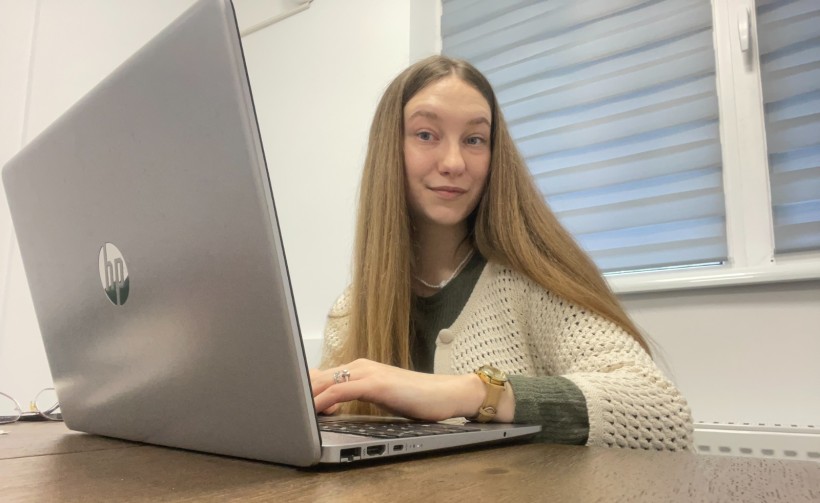
On April 10, 2026, the Department of Family, Youth, and Public Events for National-Patriotic Education of the Regional State Administration, in collaboration with the international network “Understanding Europe,” held an educational workshop titled “Human Rights” for young people in the Donetsk region to mark International Day of Liberation of Prisoners of Fascist Concentration Camps.
Guest trainer Varvara Kuznetsova, grant manager at the municipal institution “Memorial Museum of Dignity in Lviv” and European Youth Ambassador in Ukraine, provided a detailed explanation of the concept of “human rights” within the context of European institutions and the global legal order.
Together with the trainer, participants had the opportunity to discuss civil rights and the mechanisms that function to protect them through engaging exercises, and to delve into the history and provisions of the Charter of Fundamental Rights, the European Convention on Human Rights, and other policy documents. Following the theoretical portion, there were engaging interactive exercises: participants compared various situations and sought answers to questions about how each of us can protect our own rights or promote the observance of others’ rights.
The “Human Rights” workshop marked an important step in fostering legal awareness among the region’s youth. The event not only provided participants with a solid understanding of the fundamentals of human rights, international standards, and mechanisms for their protection, but also demonstrated how these principles work in real life.
For reference:
The Understanding Europe project was launched by the Schwarzkopf Foundation in 2004. In collaboration with the European Youth Parliament, a network of young volunteer trainers was established. Currently, the project is being implemented in 11 countries (Germany, Armenia, Romania, Austria, Belgium, Greece, Italy, Turkey, Portugal, Spain, and Ukraine). All trainers are young people who are eager to share new knowledge about the EU and Ukraine’s European integration with other young people. Motivated volunteers strive to broaden participants’ horizons as much as possible and present different perspectives on European values.
The project’s goals are: to inform young people about EU policy, to encourage students to engage in socially beneficial activities, to inspire participants to become active citizens, to demonstrate opportunities for involvement in civic processes, and to teach them to view EU activities from various angles so that young people can form their own unbiased opinions about these processes.