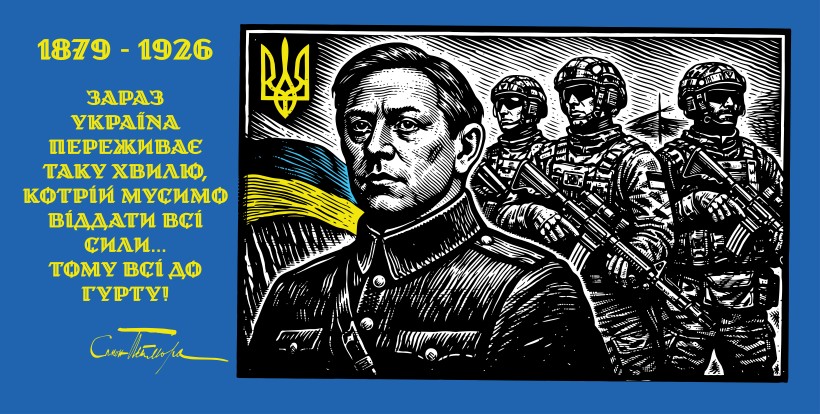
May 25, 2026, marks the 100th anniversary of the death of Symon Petliura, Head of the Directory of the Ukrainian People’s Republic and Commander-in-Chief of the Army and Navy of the Ukrainian People’s Republic.
In the context of the existential struggle for Ukraine’s independence, honoring the memory of Symon Petliura, properly recognizing and promoting his contribution to the creation of the Ukrainian state, culture, and military, is of particular importance.
Symon Petliura is a symbol of the Ukrainian national liberation movement.
As the head of the Ukrainian state, the organizer of the Ukrainian armed forces during the Ukrainian Revolution, and the Chief Ataman of the Army and Navy of the UNR, he made an exceptional contribution to Ukrainian state-building in the early 20th century and to the resistance against Russian aggression during the Ukrainian Revolution of 1917–1921.
It was precisely in the confrontation with Bolshevik Russia that Symon Petliura became, for Ukrainians, the embodiment of the idea of freedom, and for enemies—a bandit whose name was given to entire generations of followers. Petliurists, like Mazepists and Banderists, instilled fear and hatred in Russians, for it was precisely such powerful figures as Mazepa, Petliura, and Bandera who awakened a love of freedom, tenacity, and indomitability in Ukrainians.
In academic publications, textbooks, and dictionaries of the USSR, “Petliurism” was defined as “a counterrevolutionary bourgeois-nationalist movement in Ukraine during the period of foreign military intervention and civil war, led by Petliura, one of the leaders of the petty-bourgeois nationalist party of Ukrainian Social Democrats.” Participation in “Petliurism,” that is, in the struggle for an independent Ukraine, remained a pretext for accusations in the USSR for a long time. Petliurists were portrayed exclusively in negative contexts; they were given unflattering epithets and an unpleasant appearance. The image of Petliurists as pests, traitors, and opponents of the new Soviet power quickly became part of Soviet everyday life.
Throughout his life, Symon Petliura fought for Ukrainian independence not only with weapons but also with words: as a journalist, art critic, and editor of leading Ukrainian magazines. During the harshest times of Russian censorship, he organized underground printing presses. Even in exile, the leader of the UPR continued his publishing work—he founded the magazines “Tabor,” “Trizub,” and others, which turned words into weapons in the struggle for a free Ukraine.
In 1921, Symon Petliura was forced to leave Ukrainian territory. However, he did not abandon the political struggle for the independence of the UNR. The Soviet secret services, meanwhile, did not leave Petliura alone; they made it their goal to discredit and disgrace the name of Symon Petliura and his supporters.
The assassination of Symon Petliura made a profound impression on the Ukrainian diaspora. Oleksandr Shulhyn, a member of the UNR government and a diplomat, recalled that the event united the previously fragmented circles of the Ukrainian diaspora. Through his life and death, Symon Petliura demonstrated that only through unity can Ukrainians survive and prevail.
It has been 100 years since Simon Petliura’s death, but he remains a symbol of the struggle for a free Ukraine. In his honor, places are named after him, monuments are erected, and murals are painted. And most importantly, the memory of Symon Petliura is immortalized in the modern Ukrainian military.
Soldiers of the UNR Army and the Chief Ataman himself wore a trident on their sleeves. Continuing Petliura’s traditions, the trident has become part of the military identity of the Ukrainian Defense Forces. Since 2017, it has been part of the uniform of Ukrainian soldiers. The 152nd Separate Jaeger Brigade was given the honorary name of Simon Petliura. The brigade’s servicemen defend our country on various sectors of the Russian-Ukrainian front.