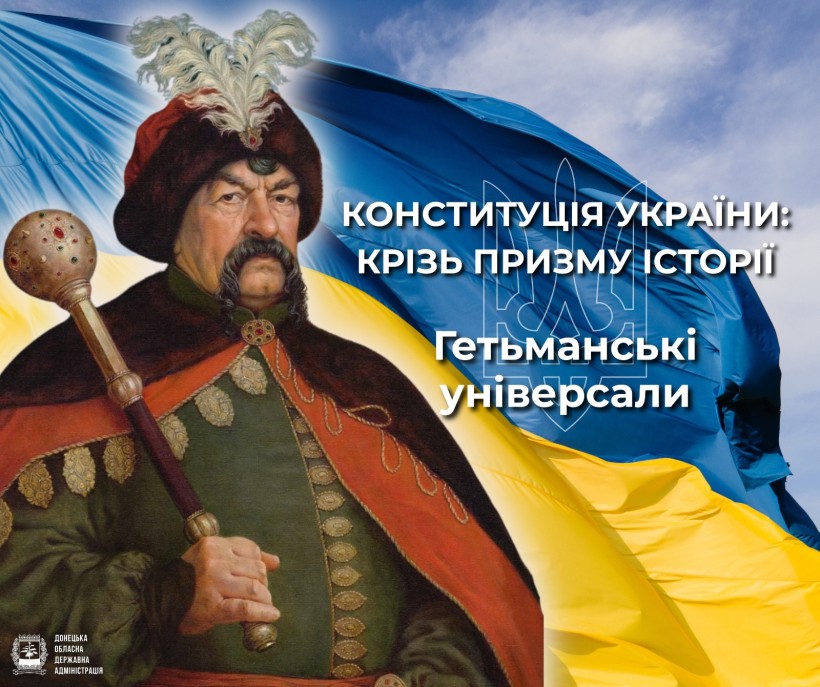
On June 28 of this year, Ukraine will celebrate the 30th anniversary of its Constitution, the country’s primary legal document. Ukrainian constitutionalism has deep historical roots and continuity, as well as its own distinctive features. It has evolved over the centuries in accordance with the national character of Ukrainians, their way of life, values, and social relations. On the occasion of Ukraine’s Constitution Day, we invite you to reflect on the major milestones in Ukrainian constitutional thought.
In early 1648, Bohdan Khmelnytsky, a centurion from Chyhyryn, launched a new uprising against the Polish-Lithuanian Commonwealth. After initial victories at Zhovti Vody and Korsun, the uprising grew into a nationwide national liberation war. In March, during negotiations with Polish commissioners, Bohdan Khmelnytsky first articulated the constitutional idea of granting Ukraine autonomy within the Polish-Lithuanian Commonwealth. In May, the hetman sent demands to the Polish government, which boiled down to “the creation of a principality with defined borders centered on Bila Tserkva.” By the end of the year, Ukraine already possessed the fundamental characteristics of statehood: a population, territory, an army, government and administrative bodies, a regimental-and-sotnia administrative-territorial structure, a judiciary, and a legal system.
With the establishment of the Ukrainian state in 1648, the process of the legal formation of domestic constitutionalism began. The Cossacks’ democratic legal customs—“ancient Cossack rights and liberties”—remained in force in the Hetmanate of Ukraine and became one of the sources of constitutional law. In the process of state-building, the hetman and the general government were guided by the Cossack system of customary law, which defined the rights and obligations of the Cossacks and regulated the activities of the general, regimental, and centurial governments. Based on the norms of Cossack customary law, a republican form of government was established in Ukraine.
The use of the legal customs of the Zaporizhian and Registered Cossacks contributed to the formation of democratic, republican institutions in Hetmanate Ukraine, such as electivity, collegiality, fixed terms of office, and the accountability and oversight of Cossack self-government bodies. The Hetman and the General Government were guided by Cossack customary law when drafting normative acts of the Ukrainian state and when concluding international agreements. Some of these legal customs were enshrined in international treaties and the laws and regulations of the Ukrainian state.
The “Statute on the Organization of the Zaporizhian Army,” adopted by the Council of Elders in June 1648, became the first constitutional and legal act of the Cossack state. The Statute was drafted on the initiative of and with the participation of Bohdan Khmelnytsky. It established the hetman’s status not only as commander of the Cossack army but also as head of state. The Statute granted the hetman legislative powers and significantly expanded his authority in the executive and judicial branches. This constitutional and legal act partially defined the rights and duties of colonels, centurions, and other Cossack officials.
International agreements became one of the most important examples of the development of Ukrainian constitutionalism and sources of Ukraine’s constitutional law. These include the Zboriv Agreement of 1649, the Bila Tserkva Agreement of 1651, the Treaty of Hadyach of 1658, the Chudniv Agreement (Slobodyshche Treaty) of 1660 with the Polish-Lithuanian Commonwealth, the Pereyaslav-Moscow Agreement of 1654, the Pereyaslav Articles of 1659, the Moscow Articles of 1665, the Hlukhiv Articles of 1669, the Konotop Articles of 1672, and the Kolomak Articles of 1687—agreements with the Muscovite Tsardom
These agreements had the highest legal force and regulated the territory of Ukraine, its state and legal status, the activities of higher and local government bodies, the administrative-territorial division, the judicial system, and the tax system. Based on Cossack customary law, these international agreements legally enshrined in the Ukrainian state the rights and freedoms of registered Cossacks, townspeople, and the Orthodox clergy, as well as the principles of electivity, collegiality, oversight, and accountability of government bodies. International agreements codified the Cossack custom requiring collegial decision-making on the most important administrative, military, financial, judicial, and other matters, and established the hetman’s accountability to the council of senior officers. The provisions regarding Ukraine’s sovereignty, the rights and freedoms of the Cossacks and other social classes, and the limitations on the hetman’s power, as enshrined in international agreements, should be considered an important component of the process of the emergence of Ukrainian constitutionalism.
The sources of Ukrainian constitutionalism during the Hetmanate era reflect the contractual socio-political traditions that existed in the countries of Central and Eastern Europe. The main contractual tradition, which served as the foundation for the development of Ukrainian constitutionalism, consisted of efforts to protect the interests of Ukraine-Hetmanate—both as a state and as representatives of its elite—through various contractual forms, thereby laying the groundwork for the legal regulation of social relations.