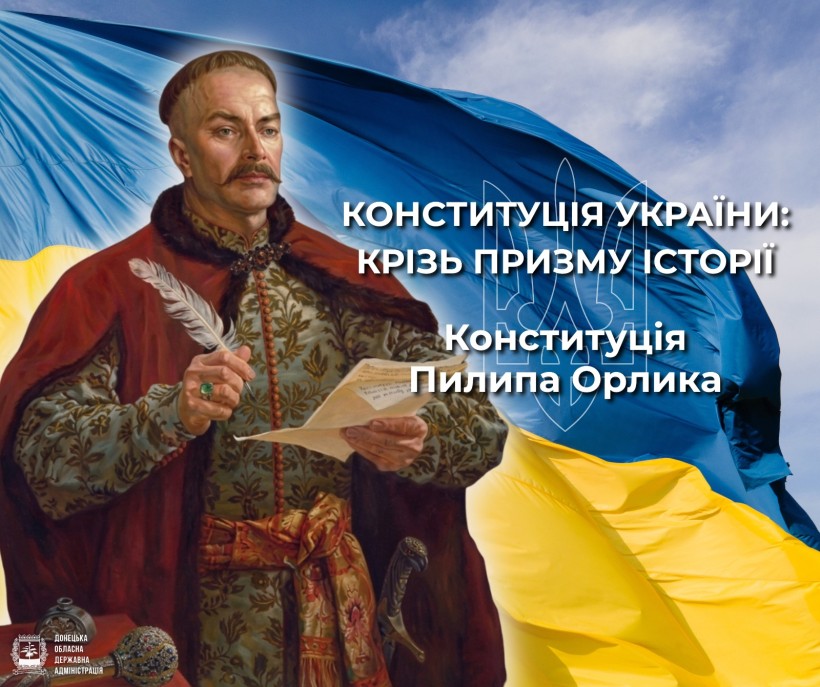
On June 28 of this year, Ukraine will celebrate the 30th anniversary of its Constitution, the country’s primary legal document. Ukrainian constitutionalism has deep historical roots and continuity, as well as its own distinctive features. It has evolved over the centuries in accordance with the national character of Ukrainians, their way of life, values, and social relations. On the occasion of Ukraine’s Constitution Day, we invite you to recall the major milestones in Ukrainian constitutional thought.
On April 16 (5), 1710, an agreement was concluded between Hetman Pylyp Orlyk, the Cossack leadership, and the Cossacks of the Zaporizhian Host, titled “Pacts and Constitutions of the Laws and Liberties of the Zaporizhian Host.” In historiography, this document is known by various names: “Charter,” “Agreement,” “Pylyp Orlyk’s Constitution,” “Bender Constitution,” and so on. The latter name stems from the fact that it was adopted at a Cossack council near the town of Bendery, in what is now Moldova. Thus, the Constitution was adopted in exile, outside Ukrainian territory. The name “Pylyp Orlyk’s Constitution” appeared later and became the most widely used.
The “Pacts and Constitutions of the Laws and Liberties of the Zaporizhian Army” defined the rights and duties of the hetman, outlined the principles of the future state structure, and established mechanisms to limit power. This legal document was signed by Hetman Pylyp Orlyk and Kost Hordiienko, the koshovo ataman of the Zaporizhian Sich.
The Constitution consisted of a preamble and 16 chapters. According to its provisions, legislative power belonged to the General Council, which functioned as a kind of parliament. The highest executive power was exercised by the hetman and the Council of General Officers, while judicial matters fell under the jurisdiction of the General Court. The preamble outlined the history of the Ukrainian people and justified Ukraine’s right to independent statehood. For the early 18th century, such ideas were extremely progressive.
One of the Constitution’s key provisions was the demand for Ukraine’s political and ecclesiastical separation from the Muscovite state, as well as the restoration of Ukrainian statehood. The principles enshrined in it—the separation of powers, the limitation of the head of state’s authority, and the accountability of the government to society—were far ahead of their time and made a significant contribution to the development of European political and legal thought.
Pylyp Orlyk’s Constitution is considered one of the first European constitutions of the modern era. It is often claimed that it is “Europe’s first constitution” or even “the world’s first constitution.” At the same time, historians treat such characterizations with caution, as there were earlier constitutional acts in history. Nevertheless, most researchers agree that Pylyp Orlyk’s Constitution is one of the first modern-style European constitutions and an outstanding monument of Ukrainian political and legal thought.
For a long time, researchers had access only to copies of the Constitution published in Latin and Old Ukrainian. This even led to doubts about the existence of the original. In 2008, Ukrainian scholars discovered the authentic Old Ukrainian text of the Constitution in the collections of the Russian State Archive of Ancient Acts in Moscow. The original diploma from Swedish King Charles XII, confirming the election of Pylyp Orlyk as hetman, is also preserved there. The authenticity of these historical documents is attested by the handwritten signatures of Pylyp Orlyk and Charles XII.
In 2021, the original Latin-language version of Pylyp Orlyk’s Constitution was brought from Sweden to Ukraine for the first time in over three centuries to be exhibited at the St. Sophia of Kyiv National Reserve. This event was a significant milestone for Ukrainian historical scholarship and once again highlighted the deep-rooted traditions of Ukrainian constitutionalism.
Pylyp Orlyk’s Constitution is one of the most significant monuments of Ukrainian political and legal thought and an important component of the centuries-old tradition of Ukrainian statehood. Its ideas marked a significant stage in the development of constitutionalism and attested to the Ukrainian people’s aspiration for freedom, self-government, and the rule of law.