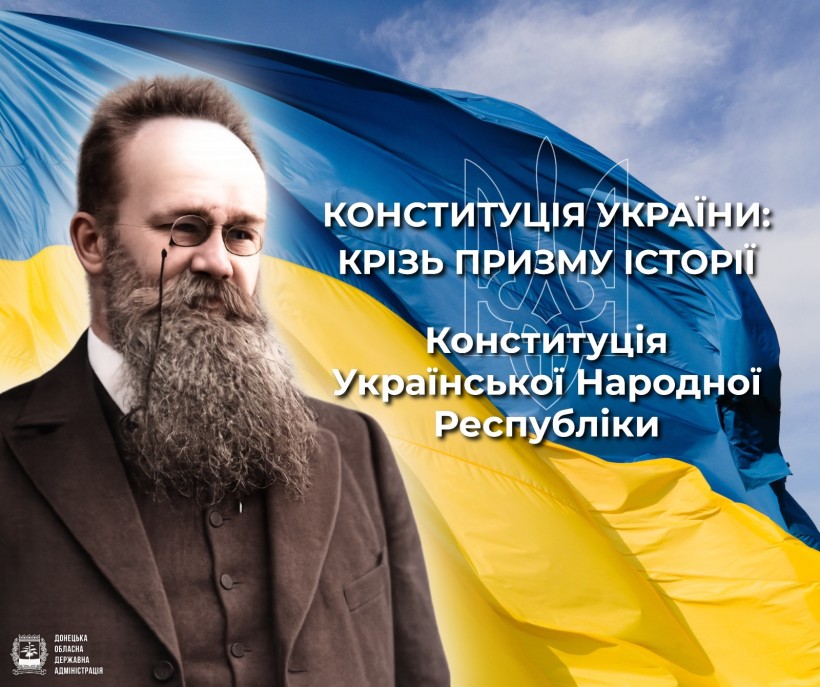
On June 28 of this year, Ukraine will celebrate the 30th anniversary of its Constitution, the country’s primary legal document. Ukrainian constitutionalism has deep historical roots and continuity, as well as its own distinctive features. It has evolved over the centuries in accordance with the national character of Ukrainians, their way of life, values, and social relations. On the occasion of Ukraine’s Constitution Day, we invite you to reflect on the major milestones in Ukrainian constitutional thought.
During the Ukrainian Revolution of 1917–1921, the constitutional process began immediately after the proclamation of the First Universal. A constitutional commission headed by Mykhailo Hrushevsky was established. It was planned that the Constitution would be adopted at the All-Ukrainian Constituent Assembly; however, the October Revolution of 1917 and the military aggression of Bolshevik Russia against Ukraine threw a wrench in the works.
The document, officially titled “Statute on the State Structure, Rights, and Freedoms of the UPR,” was adopted at a session of the Small Council on April 29, the last day of the Central Rada’s existence. The first draft was adopted unanimously. Minor editorial amendments were made during the article-by-article reading.
The Constitution of the UPR contained 83 articles, grouped into 8 chapters. The UPR was proclaimed a sovereign state, “autonomous and independent of anyone.” The Constitution guaranteed the equality of citizens, including a provision—progressive for its time—on the equality of men and women before the law, and contained a wide range of guarantees of individual rights. The death penalty was abolished, and corporal punishment was prohibited. Legislative power belonged to the National Assembly; executive power to the Council of People’s Ministers; and judicial power was headed by the General Court of the UNR. The foundations of decentralization were also laid: “Without compromising its unified authority, the UNR grants its regions, districts, and communities broad rights of self-government, adhering to the principle of decentralization.”
At the same time, a certain degree of declarative language, the absence of provisions on state symbols, the fundamental principles of domestic and foreign policy, and the procedure for electing local authorities attest to the provisional nature of the constitution—it was created for the transitional period of the formation of Ukrainian statehood.
The Constitution of the UPR enshrined in law institutions that were new to the Ukrainian legal system, in particular, the institutions of administrative-territorial division, citizenship, and parliamentary immunity, among others.
Unfortunately, the dissolution of the Ukrainian Central Rada and the establishment of Hetman Pavlo Skoropadskyi’s regime meant that the provisions of Ukraine’s first Constitution of 1918 were never implemented.
The state-building processes of this period were halted by the prolonged occupation of Ukrainian lands by its eastern neighbor. During the existence of the Soviet Union, where authoritarianism and totalitarianism reached their extreme, four fundamental laws were adopted over the course of several decades. However, all of them merely declared a certain set of democratic values, behind which a new empire was taking shape.