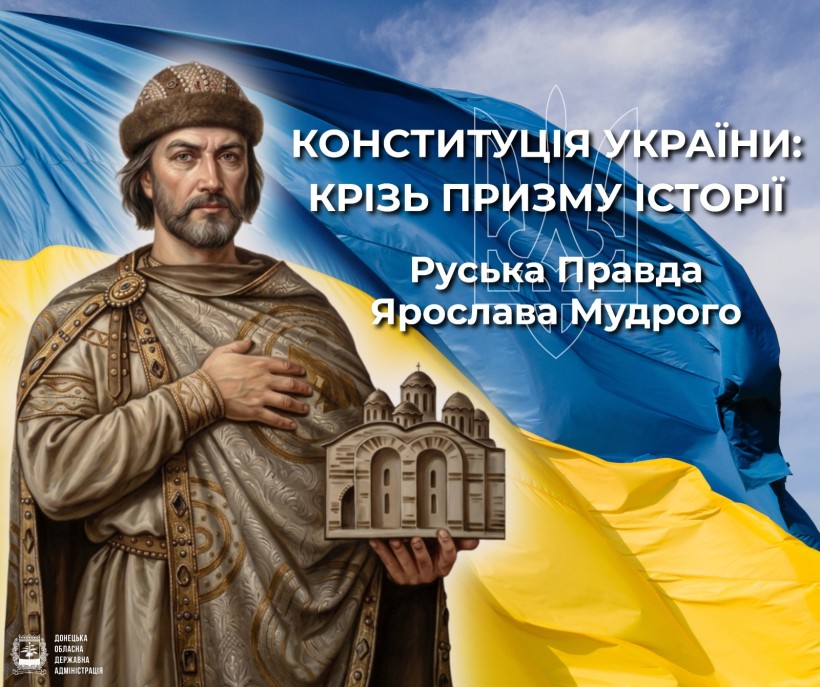
On June 28 of this year, Ukraine will celebrate the 30th anniversary of its Constitution, the country’s primary legal document. Ukrainian constitutionalism has deep historical roots and continuity, as well as its own distinctive features. It has evolved over the centuries in accordance with the national character of Ukrainians, their way of life, values, and social relations. On the occasion of Ukraine’s Constitution Day, we invite you to reflect on the major milestones of Ukrainian constitutional thought.
The first known codification of law in Ukrainian territories, which followed the legislative acts of the Germanic and Anglo-Saxon states of Europe, is the “Ruska Pravda”—the oldest known code of laws of Kievan Rus’ that has survived to this day. It is a collection of Old Russian legal norms, compiled in the 11th–12th centuries based on customary law and princely legislation.
The oldest part of the collection, known as “Yaroslav’s Pravda,” was compiled during the reign of Grand Prince Yaroslav the Wise of Kyiv in the first half of the 11th century. Later, the document was supplemented by his descendants, in particular the prince’s sons, resulting in new editions of the “Russkaya Pravda.”
The document regulated various spheres of social life: liability for murder and bodily injury, the protection of human honor and dignity, property relations, property rights, and the procedure for compensation for damages. Unlike many medieval legal codes in Europe, most offenses were punishable by fines rather than corporal punishment or the death penalty.
The original “Russkaya Pravda” has not survived to the present day. Its contents are known thanks to numerous transcriptions and copies created during various historical periods. At the same time, the document did not cover all spheres of social life. In particular, it contained limited information on inheritance law, land ownership, and the legal status of certain categories of the dependent population.
An important feature of the “Ruska Pravda” was its aim to regulate social relations on the basis of written law. This marked a significant step in the development of statehood in Kievan Rus’ and helped establish the primacy of law over personal vengeance or arbitrary rule.
Although the “Ruska Pravda” was not a constitution in the modern sense, it laid the foundations for legal culture and state governance in the Ukrainian lands. The document became one of the earliest manifestations of the desire to organize social life through a system of laws and fair judicial proceedings.
Although nearly a thousand years have passed between the creation of the “Ruska Pravda” and the adoption of the Constitution of Ukraine, both documents are united by a common goal—establishing clear rules for social life and protecting individuals through the force of law. That is why the “Ruska Pravda” is considered one of the origins of the Ukrainian legal and constitutional tradition.