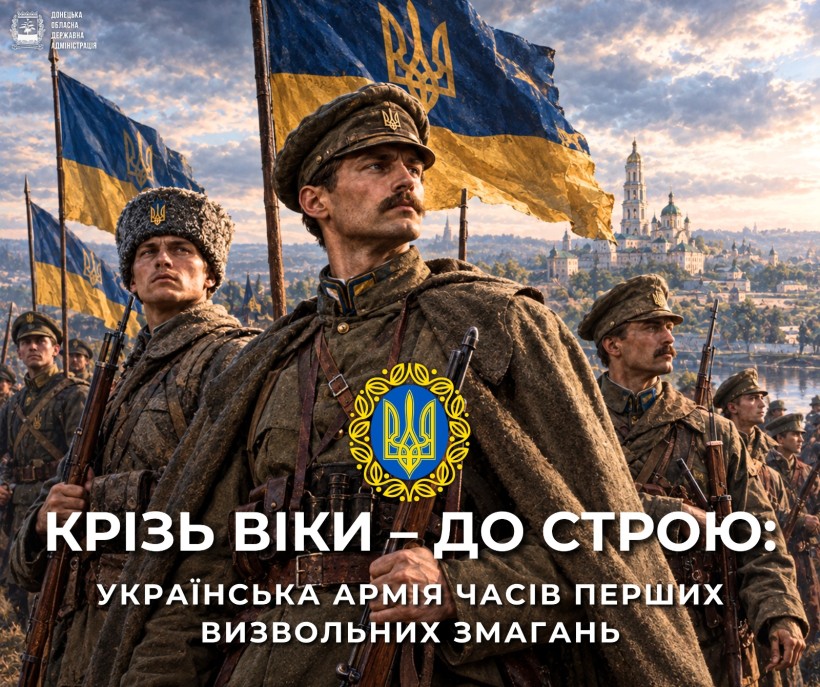
The Ukrainian military has a long history. It is a thousand-year journey of evolution, from the princes’ retinues and Cossack regiments to the ultra-modern Defense Forces of Ukraine, where the uncompromising struggle for freedom has remained the central, unifying theme throughout the centuries. Today’s defenders of Ukraine have inherited the finest military traditions of their ancestors: from the Rus’ warriors—the double-pronged and trident symbols; from the Zaporozhian Cossacks—the Cossack crimson cross and the culture of military democracy; and from the armies of the Ukrainian People’s Republic (UNR) and the Ukrainian Insurgent Army (UPA)—tactical flexibility, self-sacrifice, and an unbreakable bond with the volunteer movement. Today, the Ukrainian army is a unique digital defense force that is constantly evolving thanks to the initiative of junior commanders and the successful implementation of advanced technologies. On Defenders of Ukraine Day, we not only pay tribute to the modern military but also speak of the continuity across generations, for today our military is the direct successor and guardian of centuries-old military traditions—a shield that today protects not only Ukrainian soil but also the security architecture of the entire free world.
During World War I, more than 3.5 million Ukrainians in the Russian army and more than 250,000 in the Austro-Hungarian army fought for interests foreign to them, sometimes against one another. The first Ukrainian national unit was the Legion of Ukrainian Sich Riflemen (USS), formed in the summer and fall of 1914 within the Austro-Hungarian army. Small in number, it could not play a decisive role among the multi-million-strong armies of the Great War; however, the very fact of its existence demonstrated that, for the first time, Ukrainians had taken up arms not out of loyalty to their emperor, but for the sake of Ukrainian interests. The USS Legion was to become the core of the future Ukrainian army.
The February Revolution of 1917 not only brought down the Russian Empire but also awakened the national consciousness of Ukrainians. The Ukrainian Central Rada was established in Kyiv, which eventually became the first national parliament. However, its leaders lacked a clear vision for the future of the army. Consequently, the military took the initiative. As early as May 1917, in Kyiv, about 3,000 Ukrainian soldiers unilaterally declared themselves the 1st Ukrainian Regiment named after Hetman Bohdan Khmelnytsky, which became the first Ukrainian military unit in the Russian army. Ukrainian soldiers in other units began to follow this example.
Ukrainization spread to virtually all of Russia’s fronts and military districts. By the end of 1917, 23 infantry divisions, 1 cavalry division, and dozens of other units had been fully or partially Ukrainized. Overall leadership of the army’s Ukrainization was exercised by the Ukrainian General Military Committee, headed by Symon Petliura. In May 1917, the First All-Ukrainian Military Congress was held in Kyiv, with delegates representing nearly 1 million Ukrainians in the Russian army and navy. This and subsequent military congresses declared their support for the Central Rada and urged its leaders to take decisive action.
Ukrainian politicians were unable to harness the energy of the masses of soldiers. Dreaming of peace and socialism, they neglected military buildup. Amid active Bolshevik agitation, many Ukrainian units disintegrated and failed to defend Ukraine in January–February 1918. The collapse of the regular units forced concerned Ukrainians to form volunteer units to defend the state. The most famous of these were the Haidamak Corps of Sloboda Ukraine (commander—Symon Petliura), the Sich Riflemen (Yevhen Konovalets), and the Free Cossack units formed in Ukraine and the Kuban.
Eventually, the Ukrainian authorities realized the need for a combat-ready regular army, which began to be formed in the spring of 1918.
The new Ukrainian army was to consist of eight corps—one for each of the provinces of what was then Naddniprianska Ukraine. Each corps was to consist of two infantry divisions (each comprising four (later three) infantry regiments, three artillery regiments, and support units), a heavy artillery brigade, and other units. In addition, four corps were each assigned one cavalry division (4 cavalry regiments, 1 horse-drawn artillery regiment, and support units), while one corps was assigned a cavalry brigade (2 cavalry regiments). The organization of the Russian army served as the basis.
During the time of the Ukrainian State, the development of the army continued. In particular, the formation of a registry of regular units was completed, their staffing levels were finalized, and many other minor details regarding organization, supply, military justice, personnel training, and other issues important to the functioning of the army were worked out.
During the revolutionary period of 1917–1921, the Ukrainian army had its own uniforms, insignia, and flags, which distinguished it from other armies of the time. The uniforms were modeled after traditional Ukrainian folk clothing and earlier military traditions: long-tailed coats, wide trousers tucked into boots, and a fur-lined cap with a peak. Alternatively, they were modeled after the uniforms of the world’s leading armies, particularly those of Great Britain: a “French-style” tunic with four large patch pockets, trousers worn with laced boots, and caps made of the same fabric as the tunic.
During the Ukrainian Revolution of 1917–1921, there were quite a few designs for military awards and decorations. However, only two of them were actually produced and used—the “Decoration for Combatants and the Wounded” in the Galician Army and the “Iron Cross for the Winter Campaign and Battles” in the Army of the Ukrainian People’s Republic. The “Decoration,” in the form of a chevron made of a blue-and-yellow ribbon on the left sleeve above the elbow, was introduced in the Galician Army in 1919 to distinguish soldiers on the front lines who had served at least 12 weeks in the trenches, participated in at least one battle, or been wounded. In the latter case, the decoration was supplemented with a red stripe between the inner ribs of the chevron. The Iron Cross for participation in the Winter Campaign of 1919–1920 was approved by Symon Petliura in October 1920, and the first awards were presented in late 1920. There were separate versions of this award for women (worn on a rosette rather than suspended from a ribbon) and for priests (a large thimble cross). Ukrainian soldiers often wore various unofficial insignia and dog tags, as well as unit and military school insignia.
Despite the defeat of the Ukrainian armies, their veterans had no intention of ceasing the struggle for Ukraine’s freedom. For some time in the 1920s, Ukrainian military structures remained intact in internment camps in Poland, Romania, and Czechoslovakia. In anticipation of an armed conflict with the USSR, veterans of the UNR Army maintained their combat readiness by training at the Polish Higher Military School (General Staff Academy) and serving on contract in the Polish Army.
Other veterans established a number of underground and insurgent organizations, the most influential of which was the Ukrainian Military Organization (UVO), later reorganized into the Organization of Ukrainian Nationalists (OUN), founded by Yevhen Konovalets, commander of the Sich Riflemen.
With the outbreak of World War II and the Second Liberation Struggle, the First Liberation Struggle became a distant memory. New heroes emerged, ones closer to the present. Thus, the memory of the events of 1917–1921 faded.
It was only with the start of Ukraine’s modern War for Independence that the approach to the legacy of the heroes of the First Liberation Struggle changed. For example, the new uniforms and insignia of the Armed Forces of Ukraine, approved in 2017, incorporated certain elements from the uniforms of the 1917–1921 period, the most notable of which is the trident on the sleeve. And the new uniform of the honor guard was modeled after the 1918 uniform of Hetman Pavlo Skoropadskyi’s Convoy (personal guard). Honorary unit names linked to figures and events of the First Liberation Struggle have also been introduced: among them are the 7th Tactical Aviation Brigade of the Air Force—named after Petro Franko (son of the famous writer Ivan Franko, who served as a pilot in the Galician Army); the 28th Separate Mechanized Brigade of the Army—named after the Knights of the Winter Campaign; the 36th Separate Marine Brigade of the Navy—named after Rear Admiral Mykhailo Bilynskyi; the 72nd Separate Mechanized Brigade of the Army—named after the Black Zaporozhians; 93rd Separate Mechanized Brigade of the Army — “Kholodny Yar”; 406th Separate Artillery Brigade of the Navy — named after General-Horunzhy Oleksii Almazov (a renowned artillery officer of the Army of the Ukrainian People’s Republic).
The legacy of the Ukrainian army from 1917 to 1921 laid the foundation for the fundamental traditions of military development and national symbolism for the modern Armed Forces of Ukraine. And the feats of those who participated in the liberation struggle (the Battle of Kruty, the First and Second Winter Campaigns of the Army of the Ukrainian People’s Republic) shaped a code of heroic resistance and self-sacrifice for the sake of Ukraine.
Based on materials from the Ukrainian Institute of National Remembrance