
On June 16, 2025, a regional online seminar entitled “Protection of elements of intangible cultural heritage (ICH) in the context of migration and community dispersion” was held.
The purpose of the event was extremely relevant: in the context of the forced displacement of thousands of citizens due to military actions, the issue of protecting intangible cultural heritage has arisen once again. How can we preserve something that cannot be held in our hands, but which is at the heart of our identity? How can we adapt traditions to new realities and keep them alive even in a dispersed space?
These and other questions were discussed at the event, which brought together cultural and educational workers, bearers and custodians of elements of the ICH, as well as all those concerned with preserving Ukrainian cultural heritage in challenging times, on the Google Meet platform.
During the seminar, the need to not only preserve but also actively pass on cultural traditions to future generations was emphasized, regardless of the geography of the community's temporary location.
The event featured presentations by experts in the field of ICH protection and preservation:
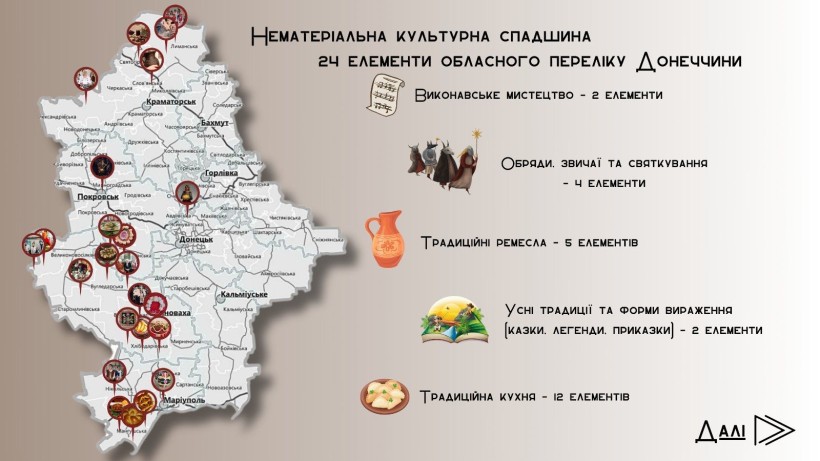
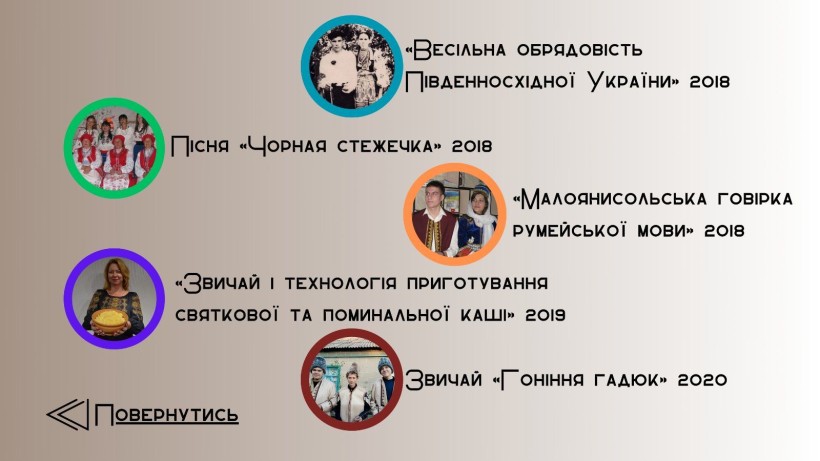
Natalia Armanovskaya, director of the Donetsk Regional Educational and Methodological Center for Culture, spoke about the general state of preservation of intangible cultural heritage in the region and the implementation of cultural projects in the region to protect intangible cultural heritage;
Natalia Aruslanova, head of the branch of the Museum of Folk Life of the Mariupol Local History Museum, spoke about Mariupol's Ikanich pysanky as a symbol of the resilience of Donetsk region traditions;
Anzhela Syvolob, director of the Katerynivka Rural House of Culture, shared her experience of how living heritage adapts to migration and continues to be a source of strength for displaced communities;
Iryna Kryuchenko, director of the Yegorivsky Cultural Center, spoke about the “Yegorivska Vesnyanka,” which is now traveling the world, demonstrating that even outside Ukraine, our elements of intangible cultural heritage can be heard loud and clear on the international stage;
Iryna Sarbei, director of the Mangush Public Library, emphasized to participants that traditions have a unifying power and can bring people together, even if they are far apart.
The participants found the second lesson of the educational project “Journey through the traditions of Donetsk region. Rreserve history!” very interesting. The project aims to teach young people to preserve and pass on elements of intangible cultural heritage in a format that is close to modern generations.
The seminar proved that our intangible heritage is alive, resilient, and extremely powerful. It is capable of withstanding the trials of war, migration, and separation, preserving our most valuable identity. And its future lies in the hands of our people.