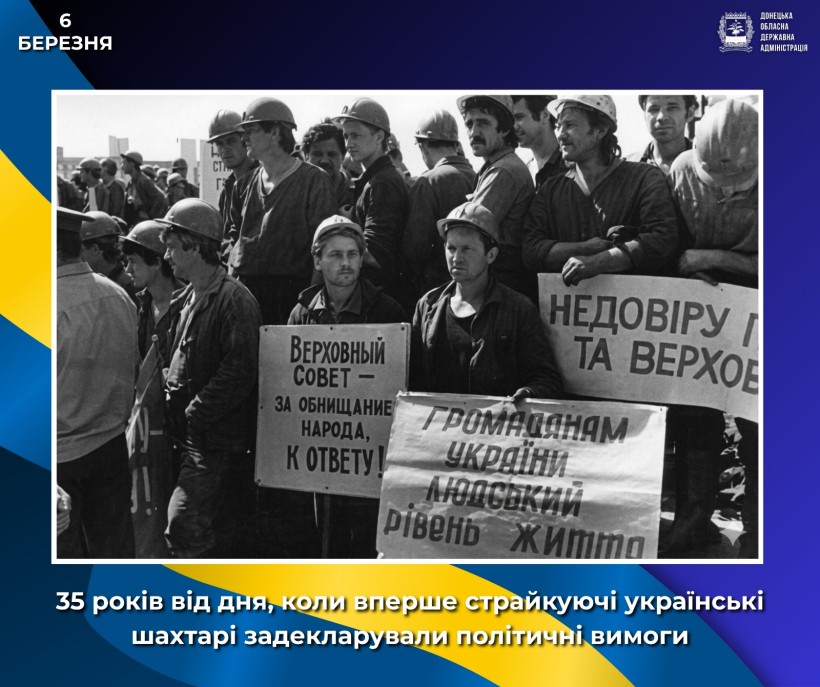
Thirty-five years ago, the Ukrainian labor movement took a step that became an important milestone on the road to state independence. For the first time, striking miners in Ukraine openly declared not only socio-economic but also political demands, thereby contributing to the formation of a new social order.
The first mass strikes by miners began in July 1989. The miners' dissatisfaction with the worsening socio-economic problems and the inability of the Soviet and republican leadership to solve them was the main reason for the strike, which began spontaneously on July 15, 1989, at the Yasinovataya-Glybokaya mine in Makiyivka. It was supported by other enterprises, and by July 25, up to half a million miners were on strike throughout Ukraine.
The strike, which began with economic demands, quickly turned into a political one in many cities. The miners forced every third mine director and many party and Soviet leaders to resign. By the end of July 1989, the authorities managed to quell the strike movement in Donbas by promising to meet the miners' demands.
One of the important results of the miners' strikes was the adoption on August 3, 1989, by the Supreme Council of the Ukrainian SSR of the Law "On the Economic Independence of Ukraine." And in Resolution No. 608 of the Council of Ministers of the USSR of August 3, 1989, miners were promised economic independence for mines and permission to export surplus production abroad. The state undertook to ensure the profitability of mines and even to improve the environmental situation in mining regions.
For the first time in years of Soviet rule, workers showed that their paths diverged from those of the Communist Party.
Over time, in the miners' struggle for their social rights, the demands of the mining movement activists began to become politicized. On March 1, 1991, a general strike of Donetsk miners began. On March 6, 1991, striking workers in the industry declared political demands for the first time: in an appeal by workers at the Stakhanov Mine (now Kapitolna) (Myrnohrad) demanded that the Declaration of State Sovereignty of Ukraine be given the status of constitutional law, that television and radio broadcasting, the press, the army, the KGB, the prosecutor's office, the Ministry of Internal Affairs, and educational institutions be depoliticized, and that real sovereignty be ensured for all republics.
"We are no longer asking, but demanding the resignation of Mikhail Gorbachev and the dissolution of parliament. We now want independence for Ukraine, our own constitution, and our own banking system," said Kapitolna mine worker Nagorny.
Forty-nine mines in the region, or 40% of the total, joined the miners' strike: 15 mines and three mine construction organizations in Donetsk, eight mines in Selidovo, seven in Pokrovsk, four in Pavlohrad in the Dnipropetrovsk region, and one each in Khartsyzsk and Lysychansk. The action was supported by 22 coal enterprises in Lviv region. For the first time, politicians joined the miners' rallies — the People's Movement of Ukraine.
Despite the common aspirations of the People's Movement of Ukraine and the Ukrainian miners' strikes, the merger of the miners' and national-democratic movements did not take place. Instead, the 1991 strikes by Donbas miners were supported by Kyiv students.
The miners' protests from 1989 to 1991, along with the Chernobyl disaster and the war in Afghanistan, are considered one of the serious blows to the Soviet Union that led to its final collapse, initiating the process of restoring Ukraine's independence.