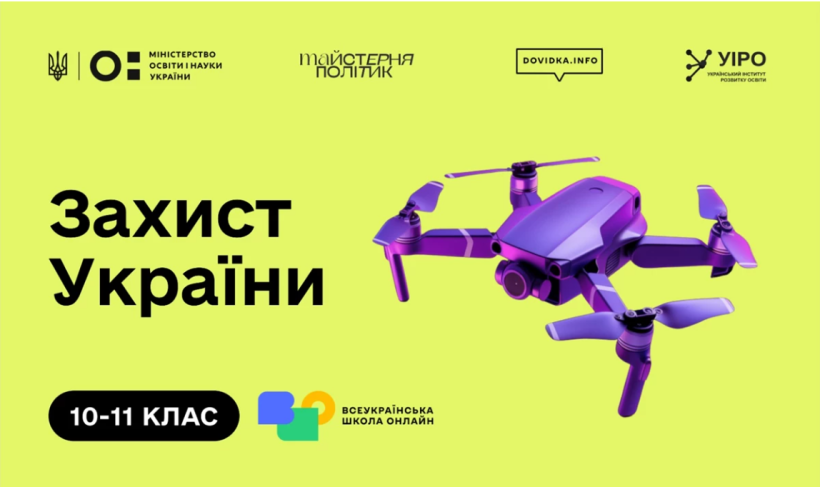
Ukrainian schools are changing their approach to one of the most important subjects in wartime – "Defense of Ukraine." Instead of formal lessons and outdated theory, 10th and 11th grade students will be taught what can truly save lives. Schools are introducing manuals for the updated program, which consists of 140 lessons, from which 36 scenarios have been developed. They are already available to teachers throughout the country.
The main innovation is the format of teaching. Instead of one lesson per week, high school students will study for a whole day once a month. The duration is 8 hours. All students will be in class together, without separation by gender.
During these classes, students will learn everything they may need in real life:
- first aid;
- rules for handling weapons;
- actions during shelling and other emergencies;
- rules of personal and digital security;
- countering recruitment and other information threats;
- basic military skills.
Currently, there are 36 full-fledged eight-hour scenarios available, divided into 140 separate lessons. Teachers can combine and adapt them to suit their class.
Training takes place in special "Defense of Ukraine" centers. These are inter-school spaces with the necessary equipment: first aid simulators, models, practical training tools, including drones.
These centers allow students to practice their skills in conditions that are as close to real life as possible. Today, there are already 963 centers operating in Ukraine (excluding Kyiv), and by the end of the school year, there are plans to create about 100 more. Starting in September 2027, this format of education will become mandatory for all high school students.
Who created these materials?
The manuals were developed by teachers and practicing teachers who are certified trainers, coaches, supervisors, and course supervisors, as well as veterans and military personnel with real experience in preparing for crisis and military situations.
The development of the manuals was coordinated by the NGO "Mastery of Politics":
"As a team that has been accompanying the reform of the subject "Defense of Ukraine" from the very beginning, it was important for us that, in addition to the updated curriculum, there were also methodological materials for teachers that could be freely used in their lessons. We wanted to help them achieve the results envisaged by the course more easily. Therefore, all our previous work was aimed at bringing together a community of proactive teachers who would be able to generate their own content.
And this summer, we managed to bring together the best teachers and practitioners from different regions of Ukraine to share and scale their teaching experience across the country. This is how we created manuals with comprehensive lesson plans, which we hope will become a useful tool for teachers of "Defense of Ukraine," says Anna Kovalenko, executive director of the NGO "Master's Workshop."
The 12th Special Forces Brigade "Azov" of the National Guard of Ukraine, the NGO "Azov.Support," the Democratic School "Maybutni," and the OSINT agency Molfar contributed to the creation of the manuals. The lessons on safety during shelling, first aid, and information hygiene are based on instructions from Dovidka.info, a project of the Center for Strategic Communications.
"The subject 'Defense of Ukraine' is not a renamed version of the old safety courses (OBZH or 'Defense of the Fatherland'). It is a modern, practically oriented discipline that prepares teenagers for the real challenges of war and emergencies. The scenarios are designed so that students not only know the safety rules but also know how to act in critical situations. For four years, the Dovidka.info project has been developing instructions that everyone should know nowadays. Now, important knowledge will be taught to children in schools," explains Mykola Balaban from the Center for Strategic Communications.
All materials have been approved by the Ministry of Education and Science of Ukraine. Teachers are invited to use the materials. Feedback and suggestions can be sent via these links: https://forms.gle/nmQAoGuAsxGihkx3A