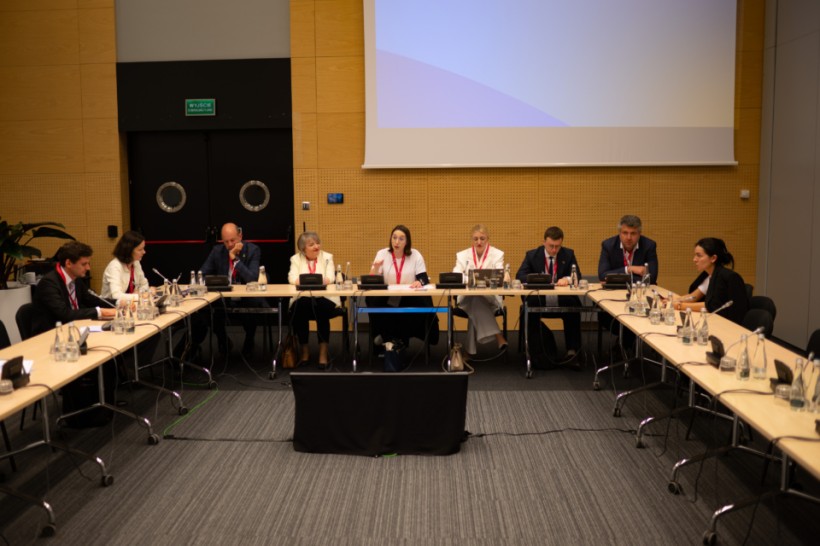
Financing Ukraine's recovery should not only help rebuild what has been destroyed by the war but also bring the country closer to membership in the European Union. This was the central message of the workshop "From Recovery to Readiness: How Investments in Ukraine's Private Sector Can Support the Country's Accession to the EU", organized by the Office of the Deputy Prime Minister for European and Euro-Atlantic Integration of Ukraine jointly with the Ukraine2EU Programme on the sidelines of the Ukraine Recovery Conference 2026 in Gdańsk.
Opening the discussion, moderator Zoya Sheftalovich, Chief EU Correspondent at Politico, framed the key question facing policymakers and businesses today: while billions of euros have already helped Ukrainian companies withstand the challenges of wartime, are these investments also preparing them to compete successfully in the EU Single Market?
The workshop opened with the presentation of the findings of the Regional Business Dialogues on European Integration initiative.
Gabriel Blanc, Head of the Ukraine Investment Framework at the European Commission's Directorate-General for Enlargement and the Eastern Neighbourhood (DG ENEST), emphasized that preparing Ukrainian businesses for participation in the EU Single Market is already underway through several complementary mechanisms. Market opportunities, improved access to finance, and the gradual alignment with EU legislation are creating strong incentives for businesses to modernize in line with European Union standards.
Mantė Makauskaitė, Head of the Ukraine2EU Programme, stressed that business readiness for European integration begins with the understanding that Ukraine's accession process is no longer a distant prospect.
She noted that the Regional Business Dialogues on European Integration initiative was launched not only to communicate this message to entrepreneurs but also to establish a permanent platform for dialogue with businesses across different sectors of the economy.
The workshop also featured the presentation of the new Ukrainian-Lithuanian Business Partnership Programme, launched by the Governments of Ukraine and Lithuania during the Ukraine Recovery Conference 2026. The programme aims to help Ukrainian and Lithuanian companies transform partnership ideas into investment projects, pilot solutions, and long-term cooperation. With a budget of EUR 1 million, it will support initiatives in energy resilience, digitalization, manufacturing, infrastructure, logistics, innovation, and human capital development. Beyond supporting Ukraine's recovery, the programme is designed to integrate Ukrainian companies into European value chains and prepare them for participation in the EU Single Market.
Commenting on the role of international financial institutions, Karol Tofil, Director of International Partnerships at Bank Gospodarstwa Krajowego (BGK), noted that one of the biggest challenges remains the insufficient preparedness of Ukrainian companies—particularly small and medium-sized enterprises—to engage with European and international financial institutions. This includes shortcomings in financial reporting, corporate governance, and transparency standards expected by international investors.
Lesia Kuzmenko, Deputy Head of the European Bank for Reconstruction and Development (EBRD) Resident Office in Ukraine, explained how international financial institutions are adapting their support instruments to the needs of Ukrainian businesses. As an example, she highlighted the EBRD initiative launched this year to help companies in the agricultural sector prepare for Ukraine's accession to the European Union.
Workshop participants agreed that expanding businesses' access to finance requires more than new financial instruments alone. Equally important are stronger advisory support, greater awareness of existing financing opportunities, and closer cooperation among governments, business associations, and international financial institutions. Such coordinated efforts will ensure that the opportunities created by Ukraine's recovery and European integration are accessible not only to large exporters but also to medium-sized manufacturers and smaller regional companies serving the domestic market.