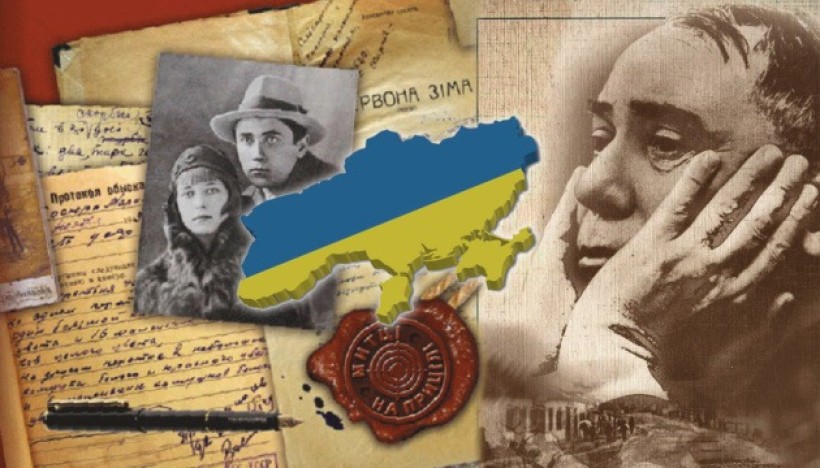
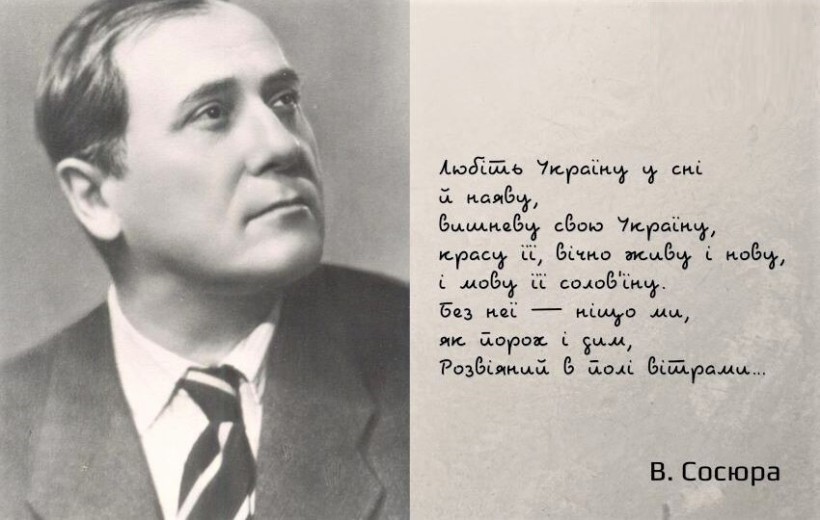
In January 1898, Volodymyr Sosyura was born in Debaltseve, in eastern Ukraine. He would become a future classic, whose fate and work reflected a turbulent era. His native land — Debaltseve, Treta Rota, the steppes of Donetsk region above the blue Dnieper — shaped his gentle, sensitive, yet courageous poetic nature. It was here, amid the hum of factories and hard labour, that the young Sosyura learned to earn a living early on, working on the railway and in the landlords' gardens, while books became his ‘salvation from everyday life’ and his first school of thought.
Despite frequent moves and a lack of systematic education, he had a phenomenal memory and began writing poetry in his youth. At first in Russian, and later, during the liberation struggle, he consciously switched to the Ukrainian language. In 1918, his first collection, Songs of Blood, was published, but unfortunately, none of the copies have been found to this day.
At the age of 20, Sosyura voluntarily joined the army of the Ukrainian People's Republic, fought in the Third Haidamak Regiment, and was a comrade and supporter of Simon Petliura. After the defeat of the Ukrainian People's Republic, the young poet, like many others, had to ‘rewrite’ his biography, because in 1919 he came under the scrutiny of the Bolsheviks. He was captured twice and sentenced to death by firing squad: Denikin's bullet hit him in the chest but did not kill him, and the Red Army soldiers released him. It is a wonderful story that the artist never tired of retelling: before his execution, he began to read poems, and the moved Red Commissar cancelled his sentence. The echo of these events can be found in the constant references to executions in his works.
In the 1920s, Sosyura became one of the most prominent poets of new Ukrainian literature. The poem ‘Red Winter’ (1921) brought him resounding fame, although it later became a source of political controversy. Interestingly, when Sosyura entered the institute in 1923, his level of knowledge was significantly higher than that of his fellow students.
The peculiarity of Sosyura's inner world was evident even in the smallest details. In joint photographs with other writers, he almost always stood slightly apart, lost in his thoughts, gentle and delicate, not prone to the usual ‘pose’ rhetoric. This was not shyness, but a reflection of his uniqueness: a poet who was always alone with the word.
During World War II, Sosyura worked as a war correspondent, writing emotional poems, experiencing the war as ‘a battle between people and monsters and machines.’ During the liberation of Kyiv in 1944, he wrote his most famous poem, ‘Love Ukraine.’ The work instantly became popular, but at the same time led to persecution, accusations of ‘nationalist distortions’ and dramatic events in the poet's life. Officials were particularly irritated by the line that ‘without her, we are like dust and smoke.’ Only after Stalin's death was the poem rehabilitated, albeit with censorship changes. Today we read it in its original form.
Despite numerous bans, periods of isolation, treatment in a psychiatric hospital and deprivation of his party membership card for ‘zoological nationalism,’ Sosyura retained a childlike, sincere, tender and anxious soul. His weak, quiet voice was not oratorical, but it was precisely this ‘colourlessness’ that made his readings so penetrating: ‘When you read too loudly, all your energy goes into the power of the sound - and nothing is left for tenderness,’ he said. The halls could not accommodate all the listeners, and other writers jokingly said that they went on stage to ‘warm up’ the audience before Sosyura.
His work is autobiographical, emotional, full of faith, pain and love. Sosyura left Ukraine with words that continue to resonate today, even as his native Debaltseve is undergoing occupation due to the war. His poetry has become a reminder of resilience and that love for one's homeland is a source of strength.
‘Love Ukraine with all your heart, and we will be eternal with her.’