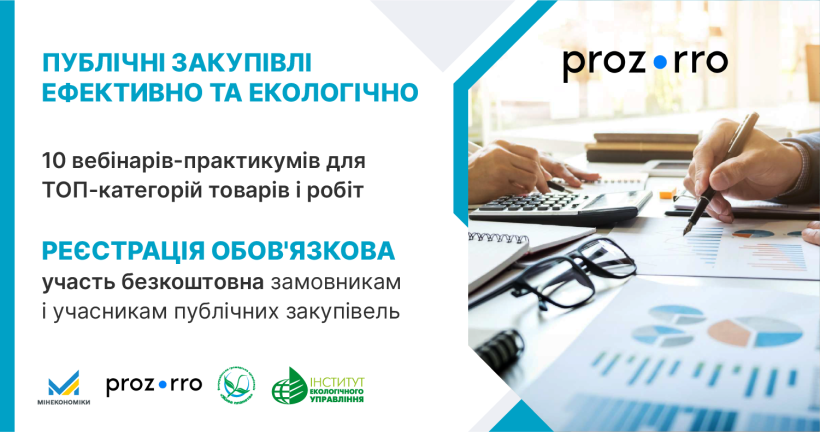
We invite you to participate in a series of free online webinars on environmental requirements in public procurement.
Green public procurement is part of European policy. The European Commission defines it as an approach that allows for the procurement of goods, works, and services with a reduced environmental impact throughout their entire life cycle.
In Ukraine, the application of environmental requirements is explicitly provided for by law, and during the webinars, experts will explain how to do this correctly.
10 thematic sessions—ranging from general approaches to applying environmental requirements in procurement to practical solutions for specific categories of goods and materials: food products, construction, cleaning products, furniture, paper, plastic, and computer equipment.
The webinars will address practical questions:
Is it possible to include environmental criteria in a tender without receiving a complaint to the AMCU?
How should environmental requirements be correctly formulated in the technical specifications?
What certificates, standards, and labels is the customer entitled to require?
How to apply non-price criteria without violating the law?
How to assess the life cycle cost of a product or service?
How to avoid common mistakes when setting environmental requirements?
Which environmental characteristics actually work for different categories of procurement?
How can procurement be made not only cheaper but also more environmentally friendly?
Maximum practicality: ready-made wording for tender documentation, common mistakes, and solutions already systematized in the “Environmental Requirements” section on Infobox Prozorro.
Webinars organized by the NGO “Living Planet” in partnership with the Ministry of Economy, Environment, and Agriculture of Ukraine and the State Enterprise “Prozorro” are launching a series of free webinars on the practical application of environmental requirements in public procurement for various product categories.
Webinar schedule (registration is open at https://forms.gle/bBoRCJUGd8Wihomt9):
March 24 – Environmental requirements in public procurement
April 16 - Food products
May 7 - Construction
June 4 - Paints, varnishes, and other materials for repair and finishing
July 2 - Detergents and cleaning products
August 6 - Cosmetics
September 3 - Furniture and wood products
October 1 – Paper products, including sanitary and household items
November 5 – Plastic products
December 3 – Computers and printers
* The webinar schedule is tentative. The organizer reserves the right to change the dates of the events. All changes will be communicated to registered participants separately.