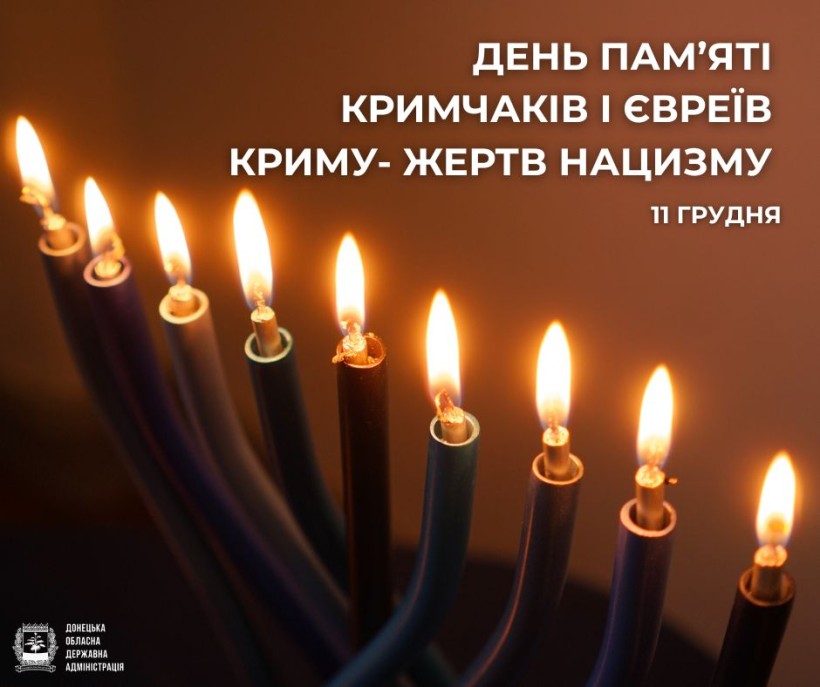
On December 11, 2025, Ukraine commemorates the Day of Remembrance for Jews and Crimean Tatars who perished during World War II. This memorable date was established by the Supreme Council of the Autonomous Republic of Crimea in 2004 to honor the victims of Nazism.
According to the 1926 census, there were 39,921 Jews and 6,000 "Crimean Jews" living in Crimea, as the Crimean Tatars were then called, representatives of one of the indigenous peoples of Ukraine that formed in Crimea. The 1939 census did not count the Krymchaks separately, according to which 65,452 Jews lived in Crimea, among whom there were probably more than 7,000 Krymchaks.
After Nazi Germany's attack on the USSR, the evacuation of the population and economy from the Crimean peninsula began. According to data from the German occupation authorities, there were 40,000 Jews in Crimea at the beginning of November 1941.
The occupation authorities considered the issue of the "racial affiliation" of the Karaites and Crimean Jews. Representatives of both groups were predominantly Turkic-speaking and associated with Judaism. Nazi agencies studied the origins of the Karaites even before the start of World War II. It was discussed later, both in the RSHA (Reich Main Security Office) and in the Ministry for the Occupied Eastern Territories, especially after Germany's attack on the USSR.
The prevailing opinion was that Karaites were not Jews by origin and did not belong to the Jewish religious community. Therefore, the Nazis did not carry out their mass targeted extermination. The Nazi regime considered Crimean Tatars to be Jews who spoke the Tatar language and were in mixed marriages with representatives of other communities. This meant their inevitable extermination by the Nazis.
In November-December 1941, the Nazis killed most of the Jews and Krymchaks in the cities. It is known that on November 20, the Jews of Yevpatoria were gathered near the train station and shot on November 25-26 (603 people were killed), and on December 9-11, 12,000 (according to other sources, more than 14,000) Jews from Simferopol, including 1,500 Crimean Jews, were killed in an anti-tank ditch at the 10th kilometer of the Simferopol-Feodosia highway, and on December 18, Jews in Yalta were taken to Magarach, where 1,500 people were shot. The Jews of Karasubazar, Bakhchisaray, Kerch, Feodosia, and other cities were completely exterminated.
It is difficult to establish the exact number of Jewish and Crimean victims due to a lack of sources, especially reports and records from rural areas. However, according to German reports, from mid-November 1941 to the end of March 1942, units of Einsatzgruppe D killed 30,211 Jews in Crimea. In particular, from November 16 to December 15, 1941, 2,504 Crimean Tatars were exterminated.
The killings continued, but were no longer as widespread. In July 1942, after the capture of Sevastopol, between 1,500 and 4,200 Jews were killed, according to various sources, including both civilians and military personnel. Taking all the data into account, most historians estimate that there were about 40,000 victims among Jews and Crimean Tatars.
After the Nazis were expelled from Crimea, only 499 people remained alive. Researchers say that the Nazis killed about 80% of the Crimean Tatars from their pre-war population. The loss of the main part of the ethnic community had irreversible consequences. Among those killed were almost all representatives of the older age group — the keepers and bearers of traditions, language, and culture.
Among the inhabitants of the Crimean peninsula were those who, under the threat of imminent death, rescued and hid Jews and Crimean Tatars from Nazi extermination. Currently, 68 names of Righteous Among the Nations who lived in Crimea are known.
Based on materials from the Office of the President of Ukraine in the Autonomous Republic of Crimea