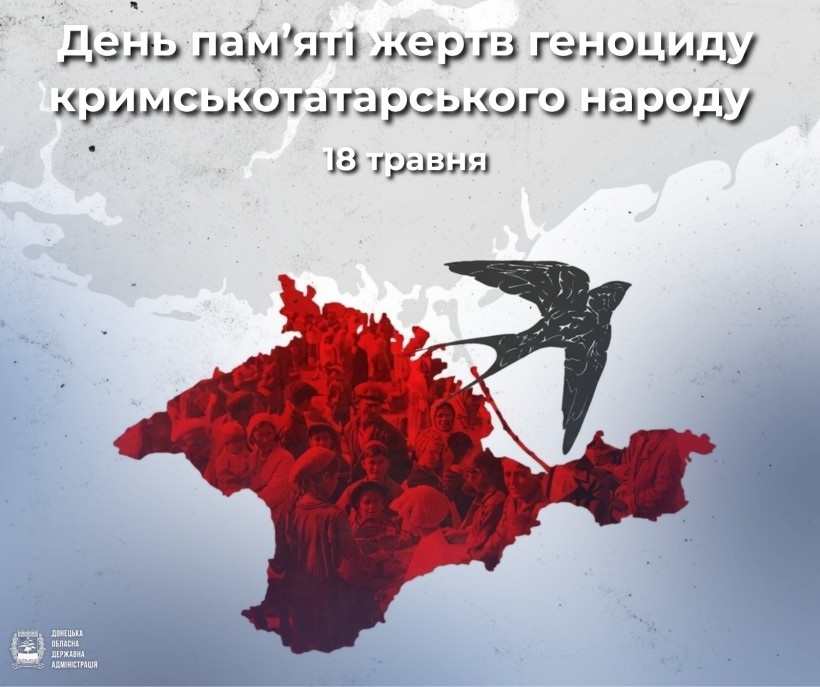
On May 18, 1944, the Stalinist regime began the mass deportation of Crimean Tatars from their historic homeland—Crimea. This crime, which in its nature and consequences meets the international definition of genocide, was an attempt to destroy the Crimean Tatar community as an indigenous people, to erase its presence from the peninsula, and to eradicate its culture, language, and traditions.
The deportation of the Crimean Tatar people by the Soviet totalitarian regime was the culmination of Russian colonial policy aimed at de-Tatarization of Crimea.
The resolution of the State Defense Committee dated May 11, 1944, signed personally by Stalin, completed the process of forcibly displacing the indigenous people of Crimea from their own land. The Soviet totalitarian regime’s policy against the Crimean Tatars was effectively a continuation of the Russian Empire’s traditions of colonizing the Crimean Peninsula, which, following the annexation of Crimea in the 18th century, carried out the expulsion of Crimean Tatars and restricted their rights and freedoms.
Thus, prior to Russia’s annexation (1783), Crimean Tatars constituted over 92% of the population within the territory of the Crimean Khanate. According to the records of the fifth census of 1795, 157,319 people resided in Crimea, of whom 126,000 were Crimean Tatars. Throughout the 18th and 19th centuries, the Russian Empire pursued a policy of constant pressure on the Crimean Tatars, restricting their rights and religious freedoms, burning religious texts, and seizing their land and resources. A significant portion of the indigenous population was forced to leave Crimea. The indigenous population of Crimea was being replaced by colonists.
The Soviet authorities planned to complete the deportation by June 1, 1944, but the repressive apparatus was once again used to “exceed the plan.” By 8 a.m. on May 18, 90,000 Crimean Tatars had been loaded onto 25 trains. On May 19, another 165,515 Crimean Tatars were deported in freight cars. Ultimately, this pace allowed the perpetrators to report to Moscow as early as May 20 that Crimea had been “cleansed” of Crimean Tatars.
During the hostilities, while the men were at the front, the Soviet authorities treacherously drove children, women, and the elderly from their homes and sent them into exile—a journey that for many became their last. The grueling journey of the deportees to special settlements in freight cars lasted an average of 2–3 weeks. Along the way, in cramped cars, without food, water, or medical care, 7,000–7,900 Crimean Tatars died of starvation and disease.
A total of 47,885 families (193,865 people, including 92,553 children under 16) were deported. As noted in the NKVD document, “of these, the following were employed in labor: men—26,092, women—50,481, children—14,614, for a total of 91,187.” This figure does not include nearly 6,000 Crimean Tatars who were imprisoned in the Gulag immediately during the deportation.
Despite their participation in the defense of the Motherland during World War II, the fate of Crimean Tatars—soldiers and officers of the Soviet Army—fully mirrored that of the peninsula’s civilian population. Directives of the NKVD of the USSR No. 1/21826 of November 16, 1944, and No. 1/1559 of August 12, 1945, categorically prohibited “sending demobilized Crimean Tatars, Crimean Bulgarians, Greeks, and Armenians—to the territory of the former Crimean Autonomous Soviet Socialist Republic.” The defenders of the Motherland found their families already in special resettlement areas. The total number of Crimean Tatars deprived of their homeland, including forced laborers and men demobilized from the Red Army after the war, amounted to 207,111 Crimean Tatars.
The deported members of the indigenous Crimean people were granted the status of “special settlers.” This entailed constant surveillance by repressive Soviet authorities, registration with military commandant’s offices, and forced labor in grueling conditions. The work was hard, especially for the special settlers, who were emaciated from hunger and disease. Their children could not attend school due to a lack of shoes and clothing. According to data from the NKVD’s Special Resettlement Department of the Uzbek SSR, in the first six months of 1944—that is, from the time of their arrival in the Uzbek SSR until the end of the year—16,052 people (10.6%) died, and in 1945, 13,183 (9.8%) died. Thus, in the first year and a half, approximately 30,000 Crimean Tatars died.
In 1948, the conditions of residence in the special settlements became even more repressive. In particular, leaving the special settlements was punishable by five days’ detention, and a repeat violation of the “residence regime” was considered “escape from the place of exile,” which resulted in a 20-year prison sentence.
The tragic history of the deportation of the Crimean Tatar people was suppressed in the USSR for decades. The Crimean Tatars were not only deprived of their homeland, but also of their own name, language, history, and identity.
After Stalin’s death, the Crimean Tatars were still not granted their rights or allowed to return to their homeland. In effect, the exile continued.
Despite the ban, beginning in 1967, Crimean Tatars made numerous attempts to settle on their own land—in Crimea. The Crimean Tatar national movement for return was one of the most effective and striking protest movements in the USSR. But in reality, mass return and repatriation began after 1987.
Only after the collapse of the USSR, in independent Ukraine, can we properly honor the memory of the victims of the genocide and speak the truth about crimes against humanity.
Based on materials from the Office of the President of Ukraine in the Autonomous Republic of Crimea