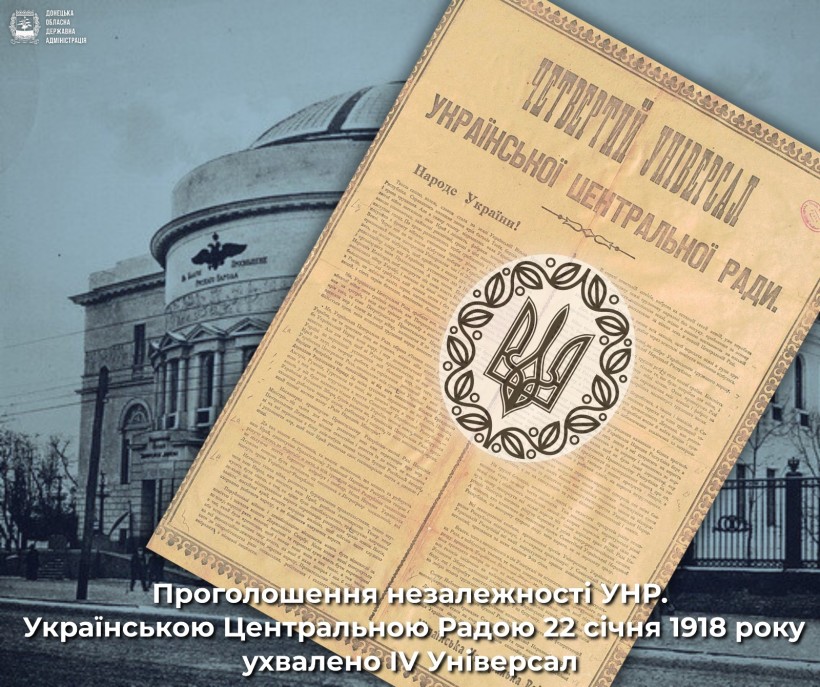
On January 9 (22), 1918, the Ukrainian Central Council adopted the Fourth Universal, which proclaimed the independence of the Ukrainian People's Republic. The adoption of this important document was preceded by a series of events.
At the end of December, Soviet troops launched a general offensive against the Ukrainian People's Republic. The Bolshevik attack hit Ukraine's major industrial centers one after another: Katerynoslav, Oleksandrivsk, Poltava, Kharkiv, and Odesa. Russian-Bolshevik troops advanced on Kyiv on four fronts (from the north, northeast, Black Sea, and Polissya). This offensive was well disguised: it was carried out under the auspices of the Bolshevik "Kharkiv Republic," and outwardly it looked as if Ukrainians were fighting each other.
It became clear to an increasing number of Ukrainian politicians that it would not be possible to rebuild Russia on a federal basis, that the desire for autonomy within Russia had not justified itself. The desire for a complete break with the Russian center was growing.
External circumstances related to the adoption of the Brest Peace Treaty also contributed to this. The position of the Ukrainian delegation in Brest, where the peace negotiations were taking place, was complicated by the fact that the Third Universal (November 1917) proclaimed the Ukrainian People's Republic, but in a federation with Russia. Now, in Brest, Lev Bronstein-Trotsky and representatives of some European states argued that only a sovereign state, independent of anyone, could sign it. Then the Central Rada decided to speed up the proclamation of Ukraine's independence.
From the context of events, it is clear that the urgent declaration of the sovereignty of the Ukrainian People's Republic was necessary to make peace with the states of the Quadruple Alliance at the negotiations in Brest and to obtain military assistance from them to repel Bolshevik aggression.
The Central Rada decided to take the decisive step of proclaiming the independence of the Ukrainian People's Republic with the Fourth Universal after it was convinced of the support for the idea of Ukrainian independence both from society and from a number of key foreign countries at that time.
Success on the international stage was ensured by diplomats, whose delegation successfully conducted peace negotiations with the Quadruple Alliance states in Brest. By that time, the Ukrainian delegation was already certain of the readiness of the Central Powers (primarily the German Empire and Austria-Hungary) to recognize Ukraine's independence and provide it with military support.
Within the country, the main support for Ukrainian independence came from nationally conscious Ukrainian military personnel, who urged politicians to declare independence, guaranteeing their assistance and protection.
As a result of these circumstances, the Fourth Universal of the Ukrainian Central Rada was issued. Discussions on the text of the Universal lasted from January 22 (9) to January 24 (11), 1918, at a meeting of the Small Council. The vote on its adoption took place on the night of January 24-25 (January 11-12 according to the old style) 1918.
On January 25 (12), 1918, at the Pedagogical Museum during an open session of the Small Council, M. Hrushevsky proclaimed the text of the Fourth Universal, emphasizing two reasons for the decision: "to give our government the opportunity to bring the peace process to an end and to protect our country from any attacks."
The Fourth Universal proclaimed the Ukrainian People's Republic an independent sovereign state. The document was the culmination of the complex and controversial development of the Ukrainian national liberation movement, which ultimately rejected the ideas of autonomy and federalism with a long delay. The adoption of the Universal meant a final break with the imperial center. Unfortunately, however, this culminating moment in the history of Ukrainian statehood was achieved not on the wave of the rise of the Ukrainian national liberation movement, but during one of the most critical periods of its history, the civil war.
Despite the fact that the provisions of the Universal were not fully implemented due to subsequent events (the overthrow of the UCR government, the hetmanate, and further struggle), it cemented the idea of an independent Ukraine in the national consciousness, which became the basis for the further struggle for independence.