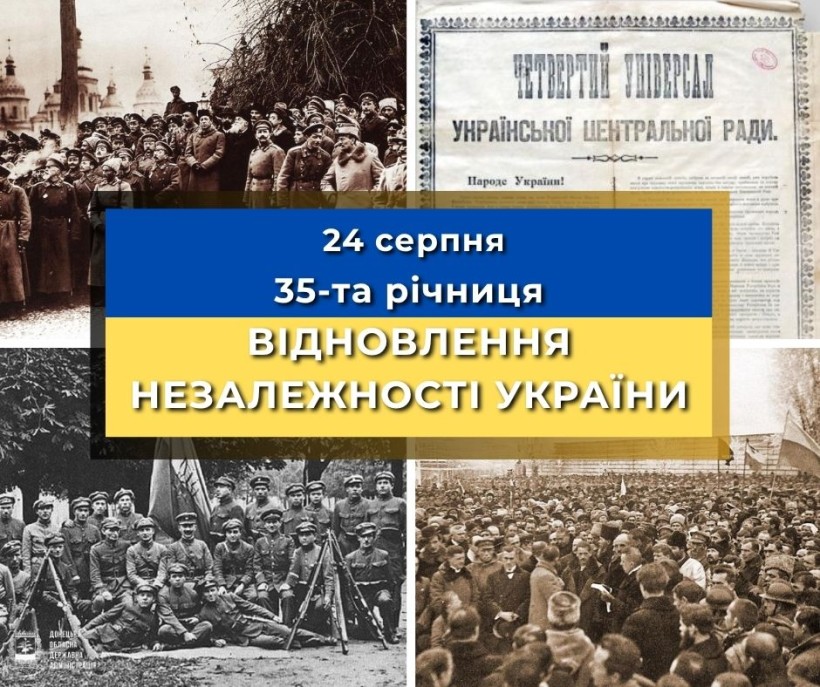
Modern Ukrainian statehood is the result of a long process of restoring sovereignty, in which each historical stage of the 20th century laid the legal and political foundation for independence, and the Donetsk region was inextricably linked as one of the key strongholds of this struggle.
Despite the long period during which Ukrainian lands were part of the Russian and Austro-Hungarian empires, the idea of sovereignty was revived during the Ukrainian Revolution of 1917–1921. This was a time when the concept of “restoring independence” took on practical meaning, emphasizing the continuity of state tradition rather than creating it from scratch. The first official declaration of independence in modern history took place on January 22, 1918, when the Ukrainian Central Rada, through its Fourth Universal, proclaimed the Ukrainian People’s Republic (UPR) an independent and free state. According to the Third Universal, the Donetsk region officially became part of the UPR, turning into the site of fierce battles for Ukrainian statehood. A Slavic military unit led by Volodymyr Sikevych operated in this region, liberating the Donetsk region from the Bolsheviks, while the local intelligentsia and railroad workers actively supported the Central Rada. On January 22, 1919, the historic Act of Unification took place—the merger of the UPR and the West Ukrainian People’s Republic (WUPR) into a single, unified state. Although the Bolshevik occupation interrupted this phase, the desire for freedom resurfaced on March 15, 1939, when the Sejm in Khust proclaimed the independence of Carpathian Ukraine under the leadership of Augustyn Voloshyn. The next attempt took place during World War II, when on June 30, 1941, in Lviv, on the initiative of the Organization of Ukrainian Nationalists, the Act of Restoration of the Ukrainian State was proclaimed and a government headed by Yaroslav Stetsko was formed; however, this movement was immediately suppressed by the Nazi occupation regime. This struggle continued in July 1944 with the creation of the Ukrainian Main Liberation Council (UMLC) as an underground parliament and government that directed the UPA’s liberation struggle.
During the Soviet period (1922–1991), Ukraine existed as the Ukrainian Soviet Socialist Republic (USSR), which, despite Moscow’s totalitarian control, allowed it to preserve its administrative borders and formal institutions of statehood. Despite Soviet myths about the exclusively “Russian proletarian” character of the Donbas, the Donetsk region remained an important center for the preservation of Ukrainian identity and resistance to totalitarian Russification, as evidenced by the activities of prominent natives of the region: the poet Vasyl Stus, the co-founder of the Ukrainian Helsinki Group Oleksa Tykhyi, and many others.
The current phase of restoring sovereignty began with the adoption of the Declaration of State Sovereignty on July 16, 1990. At this fateful time, it was the powerful miners’ strikes—which also took place in the Donetsk region—that dealt a decisive economic and political blow to the Soviet system, advancing demands for Ukraine’s sovereignty. The culmination of a century of struggle came on August 24, 1991, when the Verkhovna Rada adopted the Act of Declaration of Independence of Ukraine. This document gained absolute legitimacy in the all-Ukrainian referendum on December 1, 1991, in which 83.9% of Donetsk Oblast residents gave a resounding “yes” to Ukraine’s independence. This civilizational choice was aptly characterized by the leader of the national-democratic movement, Vyacheslav Chornovil, who emphasized that Ukraine’s aspiration for independence had always been an aspiration toward Europe and the civilized world.
A symbolic confirmation of the continuity of our free development came on August 22, 1992, when Mykola Plavyuk, the last President of the Ukrainian People’s Republic (UNR) in exile, officially handed over the UNR’s state regalia and a charter of succession to Leonid Kravchuk, the first President of modern Ukraine.
The centuries-old chronicle of Ukrainian statehood clearly demonstrates that the aspiration for freedom and unity has always united the West and the East. The Donetsk region has never stood aside from these processes, writing its own chapters in the history of the Ukrainian People’s Republic, the dissident movement, and the decisive referendum of 1991.
Today, amid the war, we are resolutely repelling the enemy and once again defending our freedom, and the future reconstruction of Ukraine will be the primary shared task of our generation. Building on a solid historical foundation, we continue to defend, rebuild, and develop our nation. May this day inspire us to new achievements for the prosperity of our homeland.