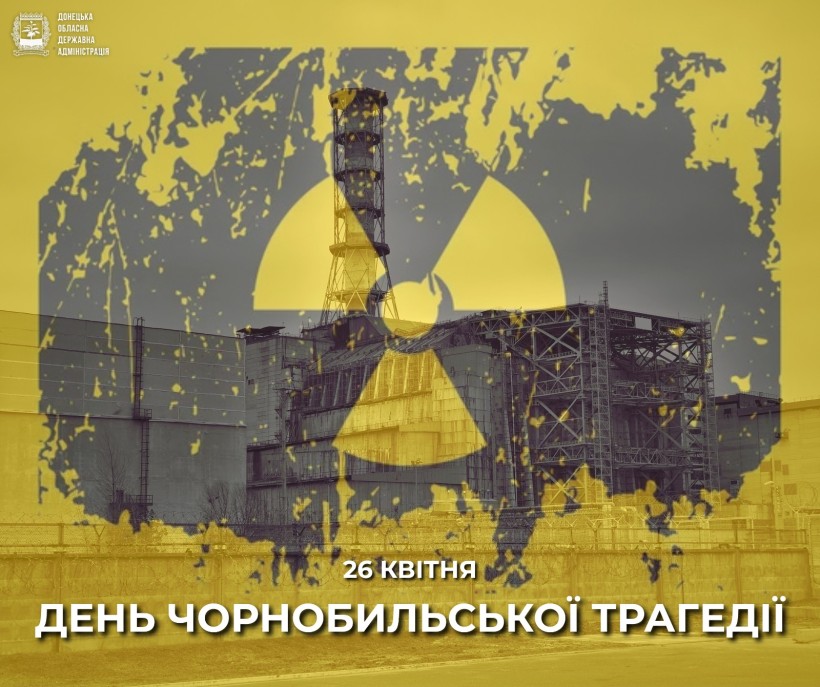
April 26, 1986, marks the day of the worst man-made disaster in human history. Forty years have passed since the accident at the Chernobyl Nuclear Power Plant, yet its consequences are still being debated by the global scientific community. According to UNSCEAR and the WHO, the Chernobyl disaster is classified as a nuclear accident of the highest level. Historians, however, emphasize the political responsibility of the communist regime, which, for the sake of ideological interests, endangered the lives and health of millions of citizens. Due to design flaws, violations of construction standards, and the use of substandard building materials, such a man-made disaster was inevitable.
On April 25, 1986, the fourth power unit at the Chernobyl Nuclear Power Plant was to be experimentally shut down to study the possibility of using the turbine generator’s inertia in the event of a power loss. Although the technical conditions did not match the test plan, the test was not canceled.
The experiment began on April 26 at 1:23 a.m. The situation spiraled out of control. At 1:25 a.m., two explosions rang out within seconds of each other. The reactor was completely destroyed. More than 30 fires broke out. The fires were fully extinguished by 5:00 a.m. on April 26. However, an intense fire later broke out in the central hall of Unit 4, which was fought using helicopters until May 10.
As a result of the accident, a cloud of radioactive dust was released into the Earth’s atmosphere. The wind carried dangerous radioactive isotopes to the northwest, where they settled on the ground and seeped into the water.
Military personnel were immediately deployed to the site for cleanup operations. The first to arrive at the disaster site were several dozen soldiers and officers from the Civil Defense Regiment of the Kyiv Military District, equipped with radiation detection devices and an army decontamination kit, a mobile chemical warfare unit, and a separate radiation and chemical reconnaissance company. According to incomplete data, 600,000 people participated in the cleanup efforts. Many of them fell ill due to radiation exposure.
Firefighters arrived “empty-handed,” without any protective gear, which allowed radioactive substances to enter their respiratory tracts. It was the firefighters who prevented another potential disaster—a hydrogen explosion. The total activity of radioisotopes released into the air after the Chernobyl accident was 30–40 times greater than in Hiroshima. Nearly 8.5 million people were exposed to radiation.
In terms of the number of victims of the accident, Ukraine ranks first among the former republics of the Soviet Union. Belarus accounted for about 60% of the harmful emissions. Russia was also severely affected by radioactive contamination. A powerful cyclone carried radioactive substances across the territories of Lithuania, Latvia, Poland, Sweden, Norway, Austria, Finland, the United Kingdom, and later—Germany, the Netherlands, and Belgium.
The Chernobyl disaster became one of the catalysts for the collapse of the USSR. Moscow’s attempts to conceal the truth about its consequences, along with inadequate safety measures and assistance to the victims, shook even the most loyal supporters’ faith in the “humanity” of the communist ideology. The Soviet authorities demonstrated a glaring disregard for people’s lives.
The first official local report of the accident at the Chernobyl Nuclear Power Plant appeared only 36 hours later—at noon on April 27, Pripyat radio announced a “temporary evacuation” of Pripyat residents—the city closest to the Chernobyl Nuclear Power Plant, with a population of about 50,000. To minimize the amount of luggage and avoid panic, people were told they would be able to return home in three days. A total of 44,500 people were evacuated. Five thousand remained in Pripyat, engaged in emergency work.
On the evening of May 1, the wind from Chernobyl shifted toward Kyiv. Radiation levels in the city began to rise rapidly. Nevertheless, the planned May Day parade was not canceled: hundreds of thousands of people, including schoolchildren, were brought out onto Khreshchatyk. The next day, all the newspapers were filled with reports of the parade.
It was not until May 2 that the Soviet leadership decided to evacuate the population from the 30-kilometer zone around the Chernobyl Nuclear Power Plant—six days after the accident. By May 6, more than 115,000 people had been evacuated from the 30-kilometer zone around the Chernobyl Nuclear Power Plant. This area was the most severely affected by radiation. It was later designated the Chernobyl Exclusion Zone. Hundreds of small villages located at the center of the contamination were razed to the ground by bulldozers.
The authorities’ concealment of the truth about the disaster and its consequences, the lack of information regarding safety measures, and the inadequate assistance provided to the victims shook the faith in the values of the communist ideology even among its most loyal supporters. Furthermore, Moscow’s attempts to conceal the truth about the disaster and its consequences strengthened the opposition national-democratic movement in Ukraine, with environmentalists—activists fighting against environmental pollution—joining its ranks.
In many regions of Ukraine, people began to take to the streets in protest against the construction of new and the operation of old nuclear power plants, as reported in the press. The Ukrainian diaspora demonstrated an active civic stance and high levels of engagement. It organized demonstrations, drafted appeals to the governments of Western nations, and compiled materials about the tragedy.
Soon, the empire built on lies collapsed.
In 2022, the Russian aggressor used the Chernobyl Nuclear Power Plant and the post-disaster protection zone to carry out aggression and a full-scale invasion. On February 24, 2022, occupying forces advancing from the Republic of Belarus entered the exclusion zone, seized facilities at the Chernobyl Nuclear Power Plant, and took the plant’s personnel hostage. In March 2022, the enemy concentrated its forces in the area of the Chernobyl Nuclear Power Plant, the “Shelter” facility, and the exclusion zone as a whole.
This had extremely dangerous consequences, including an increased risk of radioactive contamination of the area and the creation of conditions for an emergency at particularly hazardous facilities, among other things. On March 31, 2022, Russian troops completely withdrew from the territory of the Chernobyl Nuclear Power Plant.
The occupiers forced plant employees to sign “official” documents claiming that Russia had been “guarding” the facility since February 24, 2022. During their withdrawal, Russian troops managed to loot the premises, stealing equipment and other valuables. As they left the plant’s territory, the occupiers took civilian Chernobyl employees and National Guard members who were guarding it captive and transported them to Russia. To this day, not all of them have returned home.
Ukraine is a responsible country. We are protecting the world from a new global catastrophe. Despite the war, Ukraine is doing everything possible to ensure the planet’s radiation safety, contrasting its civility with Russian barbarism. We preserve memory to build a safe future.
Based on materials from the Ukrainian Institute of National Remembrance