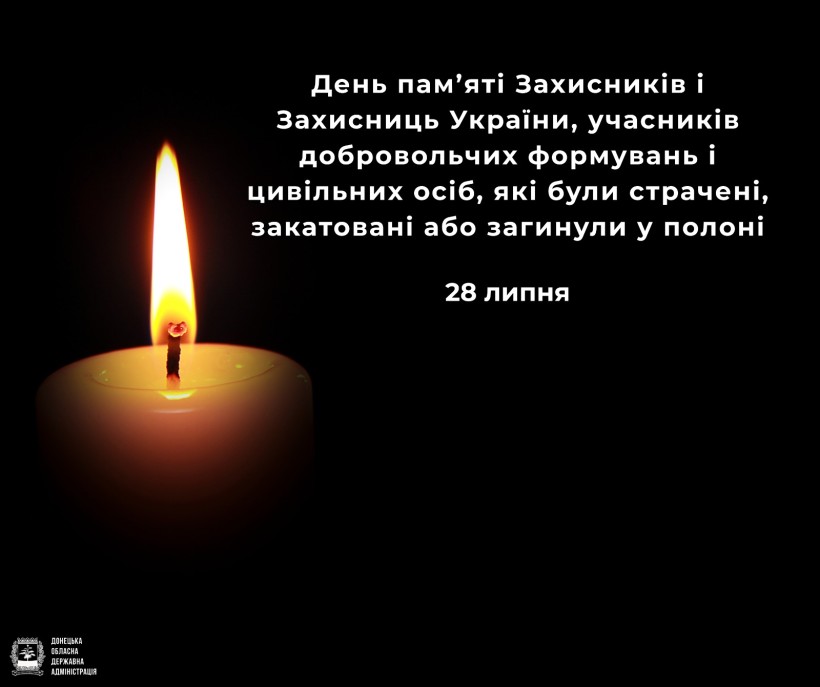
Every year on July 28, Ukraine honors the memory of the Defenders of Ukraine—both men and women—members of volunteer units, as well as civilians who were executed, tortured, or died in captivity. The corresponding resolution was adopted by the Verkhovna Rada of Ukraine on July 22, 2025, to support public initiatives and as a reminder of the tragic events that occurred during the War for Ukraine’s Independence.
The date was not chosen at random—it was on the night of July 28–29, 2022, that Russian troops shelled the Volnovakha correctional colony near Olenivka, where the defenders of Azovstal were being held. This is one of the most horrific acts of terrorism committed by Russia against prisoners of war. This crime against Ukrainian defenders constituted a gross violation of international humanitarian law, which clearly regulates the humane treatment of prisoners of war and obligates the detaining state to ensure their safety and survival.
The scale and systematic nature of the aggressor’s war crimes are confirmed by information from the Office of the Prosecutor General of Ukraine: as of June 2026, Ukrainian law enforcement agencies had registered over 200,000 criminal offenses under Article 438 of the Criminal Code of Ukraine (“War Crimes”).
According to the annual report of the Ukrainian Parliament Commissioner for Human Rights on the state of observance and protection of human and civil rights and freedoms in Ukraine in 2025, as of December 10, 2025, Ukrainian law enforcement agencies were conducting pretrial investigations in 105 criminal cases involving the killing of 337 Ukrainian prisoners of war by Russian military personnel, including at least 50 people who died as a result of a terrorist attack at the penal colony in the village of Olenivka in the temporarily occupied territory of Donetsk Oblast.
Unlike in Ukraine, the Russian Federation has not established special camps for holding prisoners of war, and captured combatants are housed in facilities of the Russian Federation’s penitentiary system as inmates. Currently, there are known to be over 180 different places of detention in the temporarily occupied territory of Ukraine and on the territory of the Russian Federation. Systematic torture and ill-treatment are widespread in these detention facilities, affecting prisoners at all stages throughout their entire period of captivity. According to data released by the UN Human Rights Monitoring Mission in Ukraine in February 2025, nearly all (95%) of the 454 released Ukrainian prisoners of war who were surveyed reported having experienced torture or ill-treatment while in Russian captivity. More than half of those surveyed had been subjected to sexual violence. Appalling conditions of detention and inhumane treatment lead to the onset or exacerbation of chronic illnesses, mental disorders, and death.
At the same time, throughout 2025, the practice of depriving Ukrainian civilians living in occupied territories of their liberty and detaining them without formally charging them with any offense, without providing them the opportunity to challenge the legality of their detention, without allowing them to communicate with the outside world, and without guarantees of a fair trial or review of their case in court, among other things, remained unchanged. Such detentions, followed by administrative or criminal prosecution, occur primarily on suspicion of loyalty to Ukraine or cooperation with the Ukrainian Armed Forces and are intended to intimidate and extend control over the population of the temporarily occupied territory.
As of December 2025, there is information that the Russian Federation has deprived 1,782 Ukrainian civilians of their liberty. At the same time, the actual number of captives may be significantly higher, as the fate of thousands of civilians who went missing during the occupation of Ukrainian territory remains unknown.
Ukraine is working tirelessly to secure the return of captives; in 2025, 11 operations were conducted, resulting in the release and return to Ukraine of 3,435 people, including 3,180 military personnel and 255 civilians who had been unlawfully held captive.
Let us bow our heads in memory of the soldiers, volunteers, and civilians who were tortured, executed, or killed while in Russian captivity. Let us pause for a moment to remember and thank all those who gave their lives for us, and to honor every heart that stopped beating for the sake of our future.