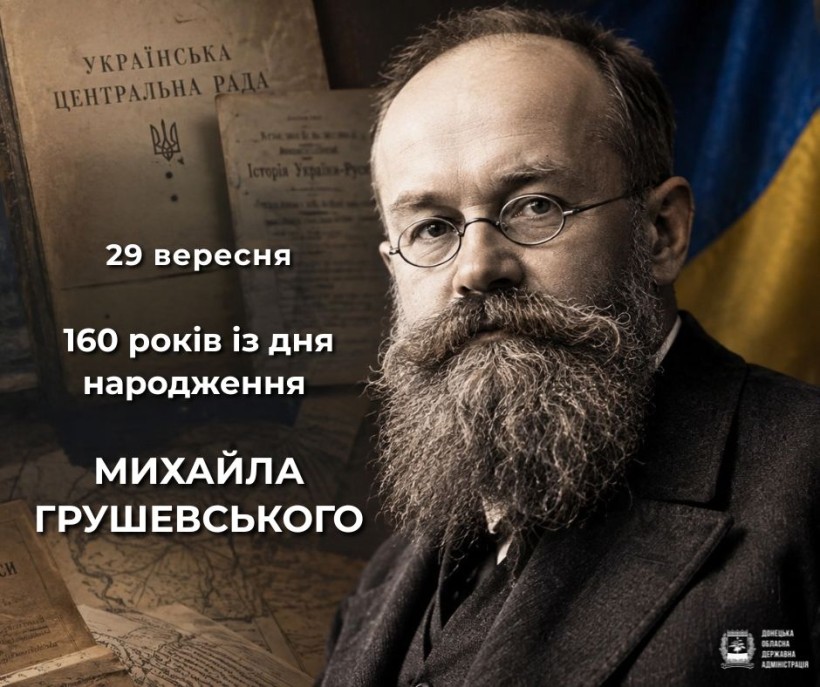
Mykhailo Hrushevsky, an outstanding Ukrainian historian, statesman, and public figure, and chairman of the Ukrainian Central Rada, was born on September 29, 1866, in the city of Kholm (now Chełm, Poland) into the family of a teacher. He spent his childhood and teenage years in the Caucasus, where he studied at the Tiflis Gymnasium. In 1890, he graduated from the Faculty of History and Philology at Kyiv University, where he studied under the guidance of the renowned historian Volodymyr Antonovych.
Scholarly work played a significant role in Mykhailo Hrushevsky’s life. After completing his studies, he conducted historical research, taught, and worked in the cities of Kyiv and Lviv. In 1894, he became a professor at Lviv University, where he headed the Department of “World History with a Special Focus on the History of Eastern Europe” and transformed the Shevchenko Scientific Society (NTSH) into a veritable unofficial Academy of Sciences of Ukraine.
It was in Lviv that his seminal work, *The History of Ukraine-Rus*, was conceived. In this multi-volume monograph, Hrushevsky systematically debunked imperial myths, restoring to the Ukrainian people their rightful heritage of Kievan Rus’ and clearly distinguishing the Ukrainian historical process from the Russian one. This work by Hrushevsky became one of the most important contributions to the formation of Ukrainian historical science and a holistic vision of Ukraine’s historical development. In total, the scholar’s academic legacy comprises approximately two thousand works on history, historiography, literature, sociology, ethnography, archaeology, and other fields of the humanities.
A special place in Mykhailo Hrushevsky’s biography is occupied by the period of the Ukrainian Revolution of 1917–1921, during which he actively participated in the key nation-building processes of that time.
After the fall of the Russian Empire, the Ukrainian Central Rada—a representative Ukrainian political body—was established in Kyiv. In March 1917, Mykhailo Hrushevsky was elected its chairman.
Under his leadership, the Central Rada progressed from demands for autonomy to the proclamation, on January 22, 1918, of the full independence of the Ukrainian People’s Republic (UPR) through the Fourth Universal. Mykhailo Hrushevsky was one of the co-authors of all four Universals of the Central Rada. And his historic speech on St. Sophia Square became a symbol of the fulfillment of the age-old dream of millions of Ukrainians. It was during this period that the Ukrainian liberation movement moved toward the practical creation of its own statehood.
After the defeat of the Ukrainian People’s Republic, Hrushevsky went into exile; however, his longing for his homeland and his desire to continue his scholarly work compelled him to return to Kyiv in 1924, where the Soviet regime was in power. The Soviet authorities initially tried to use his name to win over the intelligentsia, but later began a brutal campaign against the historian, declaring him the leader of “Ukrainian bourgeois nationalism.” The final years of Mykhailo Hrushevsky’s life coincided with a period of intensifying political repression and pressure on the Ukrainian intelligentsia. He died on November 24, 1934, in Kislovodsk. He is buried in Kyiv at the Baikove Cemetery.
Mykhailo Hrushevsky left behind a vast scholarly and socio-political legacy. He was not only a researcher of the past but also an active participant in the formation of the Ukrainian state. His scholarly, political, and civic activities contributed to the formation of Ukrainian national consciousness, the development of historical science, and the affirmation of the idea of Ukrainian statehood.
Mykhailo Hrushevsky’s legacy reminds us of the importance of knowing and preserving our own history, and of remembering those who, through their knowledge, labor, and civic engagement, worked for the future of Ukraine.