Following the defeat of the Ukrainian Revolution of 1917–1921, Ukraine lost its independence, and its territories became part of the USSR, Poland, Romania, and Czechoslovakia.
However, the Ukrainians did not give up. The government of the Ukrainian People’s Republic in exile, Hetman circles, and nationalist organizations continued the struggle to establish an independent state. During the interwar period, a young generation of Ukrainian patriots, united within the ranks of the Organization of Ukrainian Nationalists, came to the forefront.
The most radical stance was taken by the OUN(B), led by Stepan Bandera. It planned to use the German-Soviet war (which was seen as inevitable) to launch a struggle for a sovereign Ukrainian state. Marching columns (numbering up to 6,000 people) were being prepared to advance into the territory of the Soviet Union in the wake of the Wehrmacht. At the same time, the OUN(B) did not publicize its intentions, seeking to present the German authorities with a fait accompli.
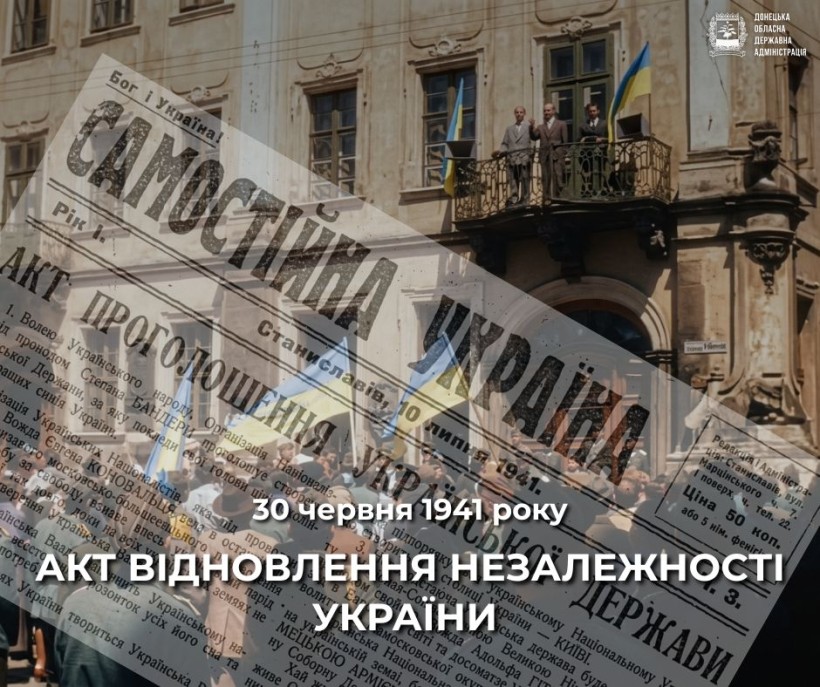
Soviet troops left Lviv on June 29, 1941. And at 4:30 a.m. on June 30, without waiting for the main forces of the German army, the northern group of the “Brigade of Ukrainian Nationalists,” led by Roman Shukhevych, entered the city to ensure the proclamation of the act of statehood.
A few hours later, a mobile group led by Yaroslav Stetsko entered Lviv; the Ukrainian National Committee had granted him the authority to proclaim independence. Negotiations with leading figures of the Ukrainian political movement were conducted promptly. And at 6:00 p.m., the Ukrainian National Assembly began at the local “Prosvita” building on Rynok Square.
The Assembly proclaimed the restoration of the Ukrainian state and the establishment of a provisional government headed by Yaroslav Stetsko—the Ukrainian State Administration. For diplomatic reasons, a third clause was added at the last moment, proclaiming continued cooperation with “Greater Germany.” However, this did not protect against subsequent repression and was widely exploited in enemy propaganda.
The Act called on Ukrainians “not to lay down their arms until a Sovereign Ukrainian Government is established throughout all Ukrainian lands.” The next step was to be the restoration of the Ukrainian state in Kyiv.
In many settlements, Ukrainian authorities were quickly established and began operating.
The preparation of the Act was carried out in secret and came as a complete surprise to the German occupation authorities. On June 30, two German officers, having heard about the gathering, arrived after it had already begun and at first had little idea of what was happening. Professor Hans Koch delivered a cautious speech, emphasizing that the creation of a Ukrainian state was not part of Germany’s immediate plans. But within a few days, the “allies’” actions became more severe.
On July 3, 1941, in a conversation with Reich Deputy State Secretary Ernst Kund, Stepan Bandera stated: “We have entered the battle that is now unfolding to fight for an independent and free Ukraine. We are fighting for Ukrainian ideas and goals. I have given orders to immediately organize the country’s administration and government in the areas occupied by German troops… I would like to reaffirm and clarify once again that with regard to all the orders I have issued, … I did not rely on any German authorities or their approval, but solely on the mandate I received from the Ukrainian people.”
Having failed to persuade Stepan Bandera and Yaroslav Stetsko to revoke the Act, they were arrested a few days later and subsequently sent to the Sachsenhausen concentration camp. On July 11, the activities of all Ukrainian organizations were banned, and in September, the Nazis began mass arrests and executions of OUN members.