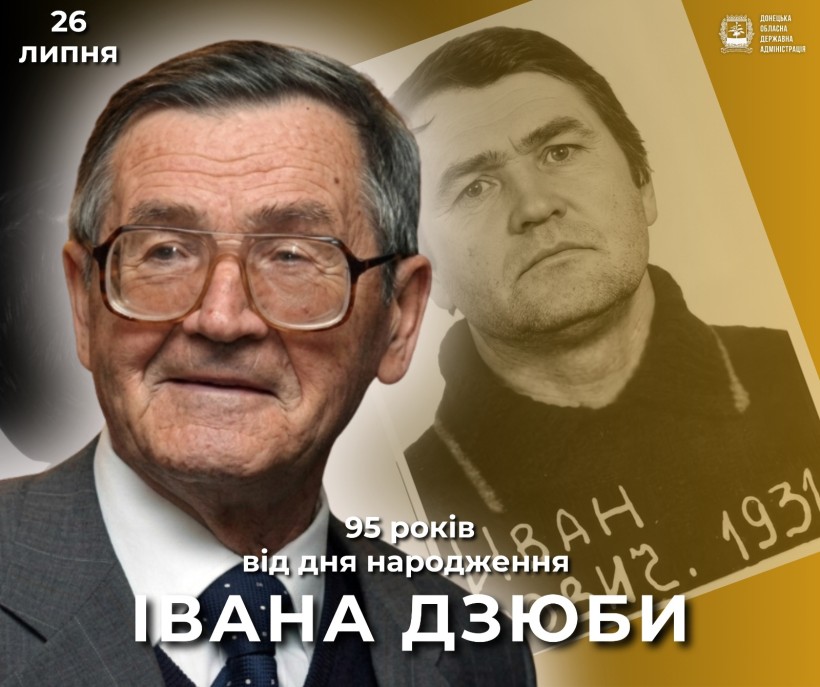
July 26, 2026, marks the 95th anniversary of the birth of Ivan Dziuba—an outstanding Ukrainian literary scholar, literary critic, publicist, dissident, Hero of Ukraine, academician of the National Academy of Sciences of Ukraine, and one of the most influential Ukrainian intellectuals of the second half of the 20th century.
Ivan Dziuba was born on July 26, 1931, in the village of Mykolaivka, Volnovakha District, Donetsk Oblast. The future scholar spent his childhood in the Donetsk region, and in 1953 he graduated from the Stalino State Pedagogical Institute (now Donetsk National University). It was in the Donetsk region that his worldview, his love for Ukrainian culture, and his commitment to defending the people’s right to their own language and history took shape.
Ivan Dziuba gained widespread recognition in 1965 after writing the work “Internationalism or Russification?”, in which he convincingly demonstrated that the official policy of the USSR led to the systematic suppression of the Ukrainian language and culture. The book was distributed via samizdat, translated into many languages around the world, and became one of the most important documents of the Ukrainian dissident movement.
At the same time, Ivan Dziuba was one of the initiators of a protest during the premiere of the film *Shadows of Forgotten Ancestors* against the first wave of mass arrests of the Ukrainian intelligentsia. This story has already become legendary; there are certain variations in different sources, and at its center are figures now well-known to us, such as Ivan Dziuba, Vyacheslav Chornovil, Vasyl Stus, and Serhiy Paradzhanov. “All those who oppose terror and repression—stand up!”—more than 50 years later, these words, which became a symbol of protest, would be printed on T-shirts, and Serhiy Paradzhanov’s film would bring fame to Ukraine and become a classic of world cinema.
Because of his civic stance, Ivan Dziuba faced persecution: he was fired from his job, arrested in 1972, and a year later sentenced on trumped-up charges of “anti-Soviet activities.” He was later forced to write a letter of repentance and was released on the condition that he would extol the “literature of the peoples of the USSR.” However, the literary scholar was not officially rehabilitated until 1990.
Until the late 1980s, Ivan Dziuba was unable to actively participate in public and political life. But in 1989, he became one of the co-founders of the “People’s Movement of Ukraine,” which played a key role in restoring Ukraine’s independence. On January 21, 1990, at the initiative of the People’s Movement of Ukraine, a “human chain” was organized—millions of people joined hands, linking Ivano-Frankivsk with Kyiv on the 71st anniversary of the Unification of the Ukrainian People’s Republic and the Western Ukrainian People’s Republic.
After Ukraine regained its independence, Ivan Dziuba actively participated in the country’s development. From 1992 to 1994, he served as Minister of Culture of Ukraine, was co-chair of the Main Editorial Board of the *Encyclopedia of Modern Ukraine*, an academician of the National Academy of Sciences of Ukraine, and the author of hundreds of scholarly and journalistic works. In 2001, he was awarded the title of Hero of Ukraine for his outstanding personal contribution to the development of Ukrainian culture and statehood.
It is interesting to note that although Ivan Dziuba studied at the Faculty of Russian Philology, he became one of the most steadfast defenders of the Ukrainian language and culture. His childhood experience of the 1932–1933 Holodomor also significantly influenced the formation of his worldview and his understanding of the value of national memory. Through his works, he convincingly demonstrated that respect for one’s own culture and language is an integral part of the existence of an independent state.
Ivan Dziuba passed away on February 22, 2022, two days before the start of a new phase in Ukraine’s War for Independence. His scholarly legacy, civic stance, and many years of work to defend Ukrainian identity remain an important part of the intellectual history of the Donetsk region and Ukraine.