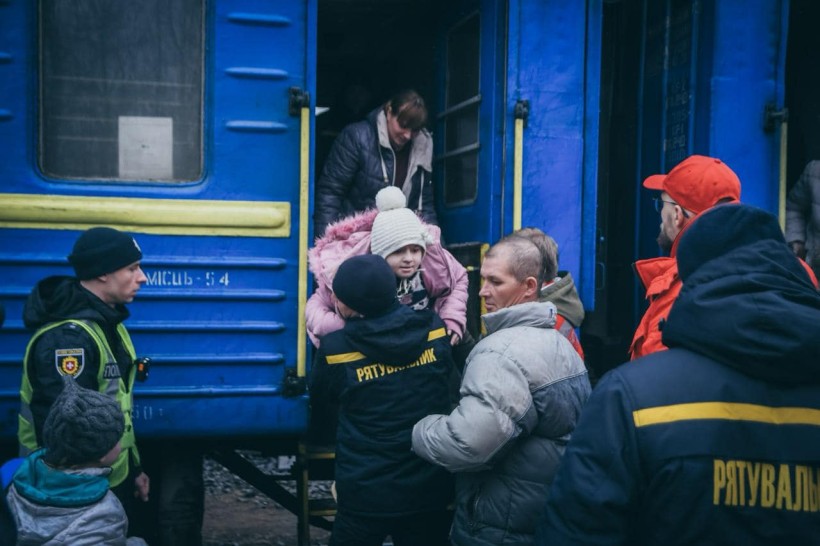
Approximately 199,000 civilians remain in the territory of Donetsk Oblast controlled by Ukrainian authorities. Among them are 13,337 children.
The progress of the evacuation in the Donetsk region was discussed during a regular briefing at the regional state administration with the participation of representatives of the Department of Civil Protection, Mobilization and Defense, the Service for Children's Affairs, and the Department of Social Protection of the Population.
In 20 communities, whose territory is recognized as an active combat zone, about 15,500 residents remain, but there are no children there. This was reported by Dmytro Petlin, head of the department of operational duty service, communications, alerting and informing the population of the Department of Civil Protection, Mobilization and Defense Work.
In Pokrovsk, evacuation is possible mainly with the help of the military or on one's own, and about 1,200 people remain. In Kostiantynivka, where the evacuation situation is better, there are 5,000 residents.
Over the past week, more than 600 people have been evacuated or left Donetsk Oblast on their own.
In two settlements where the forced evacuation of families with children is ongoing, 600 children remain. This was reported by Yulia Ryzhakova, head of the Children's Services Department. Three children remain in the village of Zavido-Kudasheve in the Kryvyi Rih rural community, and 597 children remain in Druzhkivka. Over the past week, 101 children have been evacuated from Druzhkivka.
The resettlement of evacuated Donetsk residents to safer regions of Ukraine continues. Over the past week, 36 people have been resettled, a third of whom are mobility-impaired. People were taken to the Kirovohrad, Lviv, and Dnipropetrovsk regions for free resettlement. This was announced by Dmytro Pozharsky, head of the social services division of the social protection department.
The government is launching a pilot project for long-term nursing care, which is expected to improve the resettlement conditions for single citizens with limited mobility. In the first stage, people with limited mobility will receive medical and social services at hospitals participating in the project. After the provision of medical services, hospital social workers will find shelter for such people, where they will be accommodated free of charge and receive social services in the form of shelter. The government will compensate hospitals and shelters that provide such services to evacuees from Donetsk for the corresponding expenses.
The Selidovo Central City Hospital, relocated to Odesa, will participate in this project. Soon, people with limited mobility who are evacuated from Donetsk Oblast and require nursing care will be sent there.
This project is of great importance for Donetsk region, where there are no longer any safe places. As of today, November 5, there are 1,141 single persons with limited mobility registered in Donetsk region who are being looked after by social workers. Of these, 306 people are considering evacuation in case the security situation worsens, while the rest are still considering their options.