Throughout 2025–2026, the Russian occupation authorities in the temporarily occupied territories of Donetsk Oblast have continued to demonstrate a systematic inability to maintain infrastructure and provide basic life-support services to residents.
As a result of the Russian occupation and the inefficiency of the “administrations” established by the invaders, the civilian population is artificially deprived of even minimal access to technical and drinking water—the situation is deemed critical.
Russian “administrators” and local collaborators have failed to provide the population with stable electricity and heat supply, ensure timely removal of household waste, or maintain the communal infrastructure in working order.
This complex of problems threatens the temporarily occupied region with outbreaks of epidemics and a sharp rise in morbidity and mortality rates. Moreover, information about the actual critical state of the region’s life-support infrastructure is strictly censored by the occupying authorities.
The situation regarding the observance of other fundamental human rights and freedoms also remains alarming, as evidenced by the mass illegal forced expropriation of citizens’ property, restrictions on the rights to freedom of movement, access to information, privacy of correspondence, freedom of religion, and so on.
At the same time, despite the Russians having established a strict administrative and police regime, clandestine networks of the Resistance Movement of the Ukrainian Armed Forces’ Special Operations Forces have been established and are actively operating in the temporarily occupied territories; resistance to the occupiers is being mounted by extensive networks of the self-organized Ukrainian underground, as well as individual local activists who are effectively pursuing a policy of civil resistance to the occupation.
An overall analysis of the situation indicates that the control exercised by Russian troops and “administrative structures” in the TOC is unsystematic and only fragmentary in nature. Russia’s available personnel, financial, and administrative resources in the TOT are incapable of adequately responding to infrastructure, epidemiological, social, and security crises. Consequently, the temporarily occupied territories are in fact not a “zone of effective control,” but potential hotbeds of humanitarian and man-made disasters in the heart of Eastern Europe.
An analytical report on the inability of Russian troops and the occupation administration to exercise “effective control” and guarantee the population a basic standard of living in the temporarily occupied part of Donetsk Oblast was prepared by Military Unit A4806 and covers the period from January 1, 2025, to March 20, 2026.
Water supply is the most pressing utility issue for the population of the temporarily occupied part of Donetsk Oblast.
Under international humanitarian law, the Russian authorities are obligated to ensure, to the greatest extent possible, public health and sanitation, as well as the basic needs of the local population, including access to and consumption of water.
Instead, on July 18, 2025, the occupying authorities in Donetsk Oblast introduced water rationing, limiting access to tap water in Donetsk and Makiivka to once every three days or less, with additional restrictions in other settlements. At the same time, local residents have repeatedly reported violations of even this schedule.
Public reports confirm that the water supplied by the occupying authorities to residential buildings is cloudy, has a strong odor, and is unsuitable for cooking or household use. In high-rise buildings, water often does not reach the upper floors due to low pressure in the system.
Unable to systematically resolve the issue, the Russian administration in the Donetsk region attempted to organize water deliveries by tanker trucks directly to the courtyards of apartment buildings and the private sector; however, these deliveries did not become regular. According to open sources, private vendors sold bottled water at inflated prices, making clean water unaffordable for many.
The Russian authorities attribute their long-standing inability to provide water to the Temporarily Occupied Territories to active hostilities. However, the key reasons for this are:
Corruption (in particular, over half a billion rubles were embezzled during the construction of the “Don-Donbas” water pipeline alone; the scale of the abuses was so great that the Investigative Committee of the Russian Federation was forced to open a criminal case);
A shortage of personnel in housing and utilities repair and restoration crews (in particular, due to the annual mobilization of the male population into the ranks of the occupying army);
Administrative chaos (so-called “management companies” ignore unauthorized modifications to in-building water supply systems and the installation of “private” pumps; housing and utilities departments refuse to address emergency situations; “regulatory authorities” fail to respond to numerous violations of the law, etc.);
Possible personal interest in the water shortage (according to unverified reports from local residents, the supply and sale of drinking water at inflated prices is a monopoly business run by the illegal leader of the so-called “DNR,” Denis Pushilin.
The energy infrastructure in the temporarily occupied part of Donetsk Oblast is also in a precarious state.
Throughout 2025, power grid failures were regularly reported, leading to power outages in settlements across the region. Such failures directly affected the operation of boiler rooms and water supply systems.
In early 2026, large-scale power outages occurred in certain cities in the temporarily occupied territory of the region. In particular, in Horlivka, dozens of boiler rooms were shut down due to voltage drops, leading to problems with heat supply to residential buildings and social infrastructure.
The instability of the power supply also negatively affects the operation of businesses, transportation, and communication systems.
The housing and utilities sector in the TOT region is characterized by a high level of wear and tear in utility networks and regular breakdowns.
In 2025, the occupation administration effectively acknowledged its inability to independently resolve problems in the water and heat supply sectors. To carry out repair work, they began to enlist the help of so-called “sponsor regions” of the Russian Federation.
In cities, water main breaks, flooding of residential building basements, and sewer system failures are regularly reported. Residents also complain about unsanitary conditions in courtyards and irregular household waste collection.
In 2026, the occupying authorities introduced a new system for calculating household waste collection fees, incorporating it into a single payment document. However, this did not lead to a significant improvement in the quality of services.
Human Rights and Freedoms
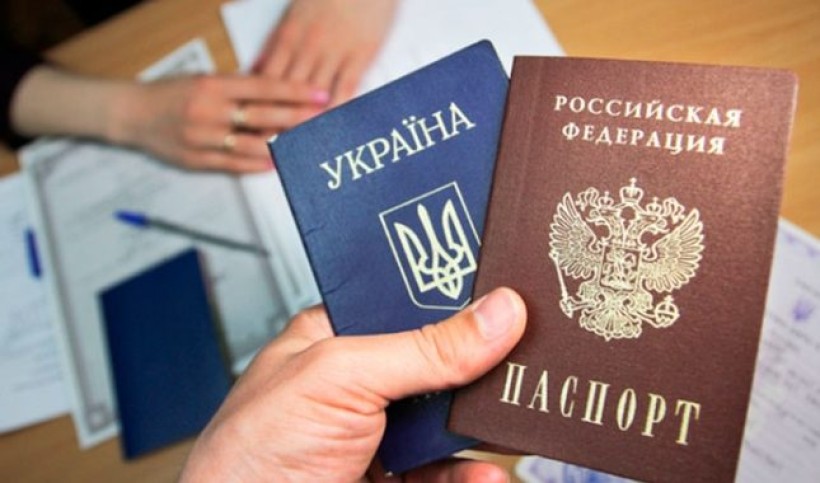
Forced Citizenship. Under international humanitarian law, the Russian Federation is obligated to respect the existing laws of the Temporarily Occupied Territories (TOT) to the greatest extent possible and to avoid radical changes to the existing order or internal characteristics of the TOT. Instead, the Russian Federation grossly violated this obligation by setting a deadline of September 10, 2025, by which all Ukrainian citizens in the TOTs were required to “legalize” their stay by obtaining a Russian passport, residence permit, or other legal basis for residence in accordance with Russian legislation, or face the risk of deportation.
Forced alienation of citizens’ property. Provisions of international humanitarian law explicitly prohibit an occupying power from confiscating private property. However, during 2025–2026 alone, the occupying authorities in Donetsk Oblast issued notices designating over 4,500 dwellings in the TOC as potentially “ownerless.” If ownership is not confirmed within thirty days of the notice’s publication, the occupying authorities may register such housing as “ownerless” and initiate “legal proceedings” to transfer it to municipal ownership. Once the property is transferred to municipal ownership, it may be transferred to third parties.
Forced conscription into the occupying army. On October 1, 2025, Russian authorities launched their autumn military draft campaign, which also extended to residents of the temporarily occupied territories of Ukraine. Unlike previous conscription campaigns, this time the Russian authorities in Ukraine’s temporarily occupied territories used a digital government system—the “Gosuslugi” portal—and sent out draft notices in digital format via citizens’ online accounts. As a result, Ukrainian citizens in the Temporarily Occupied Territories were conscripted into the armed forces fighting against their own country, which also constitutes a gross violation of international law by Russia.
Furthermore, forced mobilization is one of the causes of the collapse of the public utilities sector in the temporarily occupied territories: men who resist conscription into the aggressor country’s army are forced to quit their jobs or refuse employment at housing and utilities enterprises or critical infrastructure facilities and go into hiding, as the occupiers conduct mobilization activities directly at these enterprises.
Violations of the right to free access to information. Russian authorities are blocking access to the messaging apps Viber and Telegram, the use of VPN services, and the ability to make audio and video calls within these apps. Access to independent news outlets and popular social media platforms—that is, resources not included in the so-called “white list” or the “Russian sovereign segment of the Internet”—has also been blocked. Numerous reports indicate that state and municipal officials, as well as public sector employees, have been instructed to install the new “Max” messaging app—which is fully controlled by Russian intelligence agencies—on their mobile phones for communication with management and access to work-related chat groups.
Repression and Resistance. Throughout 2025–2026, due to their inability to impose their legitimacy on the population of the TOCs and the citizens’ rejection of the occupation regime, Russian authorities were forced to impose a harsh administrative and police regime.
In particular, in the TOT, penalties are imposed for the “public display (...) of extremist symbols.” In the temporarily occupied part of Donetsk Oblast, courts established by Russia have convicted people for actions that, under international law, constitute the lawful exercise of freedom of expression. These included, for example, the publication on personal social media accounts of patriotic Ukrainian songs, statements, or images that mocked or criticized the occupying authorities.
Restrictions on the freedom of religion or belief continue. In the temporarily occupied territories of Ukraine, Russian security forces have punished residents for “illegal missionary activities,” including holding religious services at home. In June 2025, an evangelical woman living solely on her pension in the Donetsk region was fined 10,000 rubles ($125) for organizing a worship group that sang religious songs in a private home, which was deemed “illegal missionary activity.” The court also ordered the destruction of the confiscated Bibles and hymnals. In August 2025, the head of the local branch of Jehovah’s Witnesses was arrested in Donetsk; the man is accused of “participating in the activities of an extremist organization.”
The practice of stopping people on the streets and at checkpoints for forced inspections of mobile phones for any content that could be perceived as pro-Ukrainian—including, for example, apps from Ukrainian banks—continues with an increasing trend. The Office of the UN High Commissioner for Human Rights has received reports of cases where, following such inspections, people were taken away, detained, or beaten. Mobile phone inspections are also being conducted in educational institutions, including schools. The occupiers are also attempting to encourage students to report classmates who speak Ukrainian or watch Ukrainian news.
Despite harsh punitive measures in the temporarily occupied territories (TOT), Ukrainian resistance forces are actively operating there. These include the networks of the organizations “ATESH” and “OPIR,” as well as numerous self-organized resistance cells. In addition to supporting the actions of the Ukrainian Defense Forces, the underground’s arsenal includes measures such as:
refusal to cooperate (resignation, withdrawal from duties, sabotage) by Ukrainian citizens residing in the TOC who, by virtue of their profession, could be of use to the occupying structures; refusal to be mobilized into the ranks of the Russian Federation’s army; refusal (despite having the actual capacity to do so) to fulfill commercial contracts with the organs of the occupying administration;
refusal to pay taxes (in particular, the mass distribution in the temporarily occupied territories of the guidelines “Don’t Pay Tribute to the Occupiers!”, describing legal ways and mechanisms to reduce or completely evade the payment of taxes and mandatory contributions to the aggressor country’s budgets);
collecting and documenting evidence of crimes committed by Russian military personnel and officials of the occupation administration in the territories of Ukraine seized by Russia;
acts of public resistance, such as placing graffiti featuring Ukrainian state symbols or inscriptions critical of the occupying authorities in public areas of settlements;
sabotage at military or dual-use enterprises;
preventing (through direct action or inaction) the removal by Russian entities of resources, raw materials, and valuables from the temporarily occupied territories.
Conclusion:
An analysis of the situation in the temporarily occupied territory of Donetsk Oblast in 2025–2026 indicates the occupation administration’s systemic inability to ensure the stable functioning of basic life-support systems, establish an effective system of governance, and implement efficient mechanisms for responding to emergencies.
The most acute problems are evident in the areas of water supply, electricity, and housing and communal services. Chronic network failures, unstable water supply, rising tariffs, poor sanitary conditions in settlements, and regular unprovoked repression are fueling persistent social discontent among the population of the temporarily occupied territories.
Overall, current trends indicate that Russia is incapable of performing even the most basic functions of a state in the temporarily occupied territories. Given the dangerous man-made situation in Donbas, the collapse of the housing and utilities sector, the widespread destruction of settlements, and the cluttering of the TOT with weapons, mines, and explosive devices, Russia’s continued occupation of the seized territories poses a serious threat to the entire system of regional security in Europe.
Based on materials from Military Unit A4804