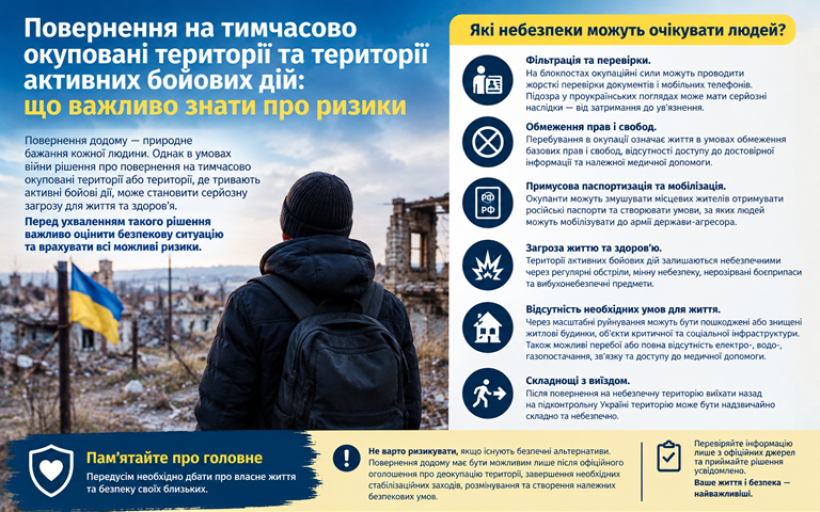
For millions of Ukrainians who were forced to leave their homes due to the full-scale war, returning to their hometown or village remains a deeply held desire. At the same time, returning to areas where hostilities are ongoing or have recently ended requires special caution.
On June 10, 2026, the Cabinet of Ministers of Ukraine approved the State Policy Strategy on Internal Displacement for the period up to 2030. One of its key objectives is to create conditions for the voluntary, safe, and informed return of internally displaced persons to their former places of residence.
The security situation in such areas can change very quickly. Even if active hostilities in the vicinity have temporarily ceased, this does not mean that the area has become safe for the civilian population.
Mine Hazard
Mines and other explosive ordnance remain one of the most serious risks in de-occupied and conflict-affected areas.
They may be found on roads and roadsides, in forests and fields, in yards, in abandoned buildings, near bodies of water, and in areas previously occupied by military forces.
The danger may be subtle: an explosive object does not necessarily look like a mine or a piece of ammunition.
The State Emergency Service recommends that you do not touch suspicious objects, do not move them, and do not attempt to defuse them on your own. If you discover a dangerous object, move to a safe distance and notify the appropriate authorities.
Interactive map of areas potentially contaminated with explosive objects
Risk of renewed shelling
In or near areas of active combat, the threat of missile, artillery, and drone strikes may persist.
The absence of shelling for a certain period of time does not guarantee that it will not occur in the future. That is why the decision to return should be based on up-to-date information from government authorities and military administrations.
Damaged housing may be unsafe
Another risk is the condition of a house, apartment, or other building.
After shelling, load-bearing structures, floors, roofs, windows, electrical systems, gas lines, and other utilities may be damaged.
Therefore, even if a house appears intact from the outside, this does not necessarily mean it is safe to live in.
Before returning, you must ensure that the residence has been inspected and is safe for occupancy.
Lack of Necessary Living Conditions
Safety is not merely the absence of immediate shelling.
It is important to consider whether the settlement has:
electricity;
water supply and access to drinking water;
heating;
medical care;
pharmacies and necessary medications;
grocery stores;
communications;
the ability to receive emergency assistance.
If critical infrastructure has been significantly damaged, returning may be dangerous even if the situation is relatively calm at the time of arrival.
Specific Risks in Temporarily Occupied Territories
Returning to a temporarily occupied territory carries additional risks related not only to hostilities.
These also include restrictions on human rights and freedoms, a lack of full access to Ukrainian state institutions, medical and social assistance, as well as other threats arising under occupation.
Therefore, the ability to physically reach a settlement does not mean that returning there is safe.
Return should only take place under safe conditions
The government is working to create conditions for the safe and voluntary return of internally displaced persons.
At the same time, a person’s final decision must be based on reliable information about the specific area, rather than on rumors, isolated social media posts, or the desire to return home as quickly as possible.
Human life and health come first. If there are still combat, mine, or other security risks in the area, it is not advisable to rush the return.