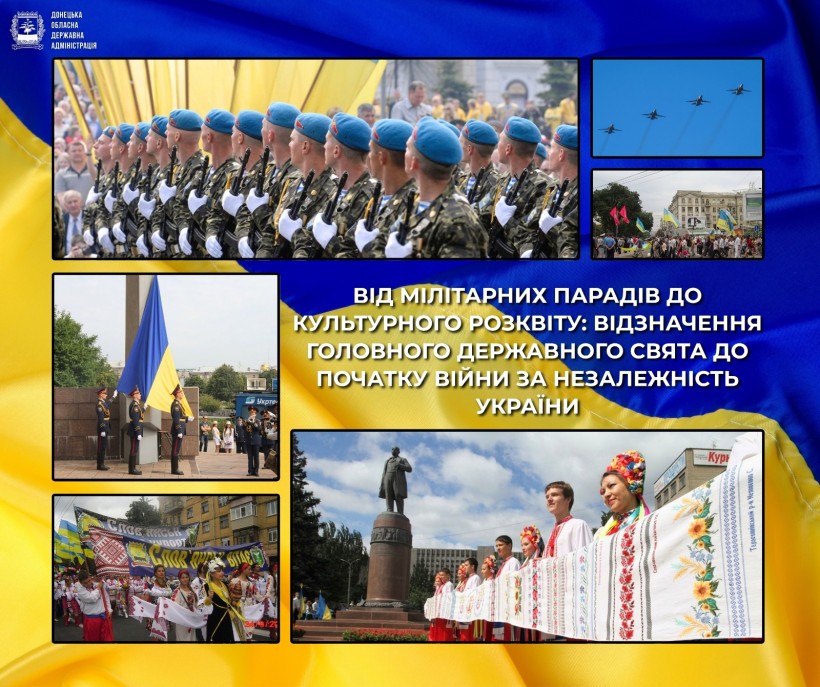
On August 24, 1991, the Supreme Council of the Ukrainian SSR adopted the Act of Declaration of Independence. The document served as legal confirmation that Ukraine is an independent democratic state. A few months later, on December 1, millions of people voted to ratify this decision in a referendum. Since then, August 24 has been Ukraine’s official Independence Day, and since 1992, this date has been enshrined in law as the nation’s main public holiday. It is the day when the country officially regained the right to live its own life after long centuries of foreign rule. In 2026, we will celebrate the 35th anniversary of that fateful date. On the occasion of this national holiday, we invite you to look back at how Ukrainians have celebrated Independence Day over the years.
From 1992 to the present, Ukraine’s Independence Day has been celebrated on August 24—the day the Ukrainian parliament adopted the “Act of Declaration of Independence of Ukraine” on August 24, 1991.
Over the years, the ways of celebrating this major national holiday have changed: for example, in the early 1990s, Independence Day celebrations included laying flowers at monuments to Taras Shevchenko, mass festivities took place across the country, and festive concerts and fireworks displays were a must.
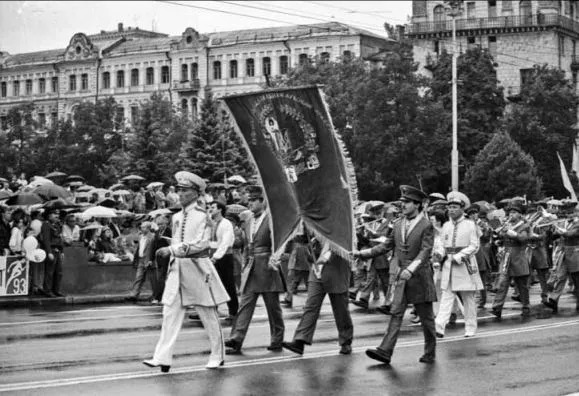
Independence Day Military Parade in Kyiv, 1994
In 1994, the first military parade in honor of Independence Day took place on Khreshchatyk. No military equipment was included in the parade. Since then, holding parades has become an annual tradition.
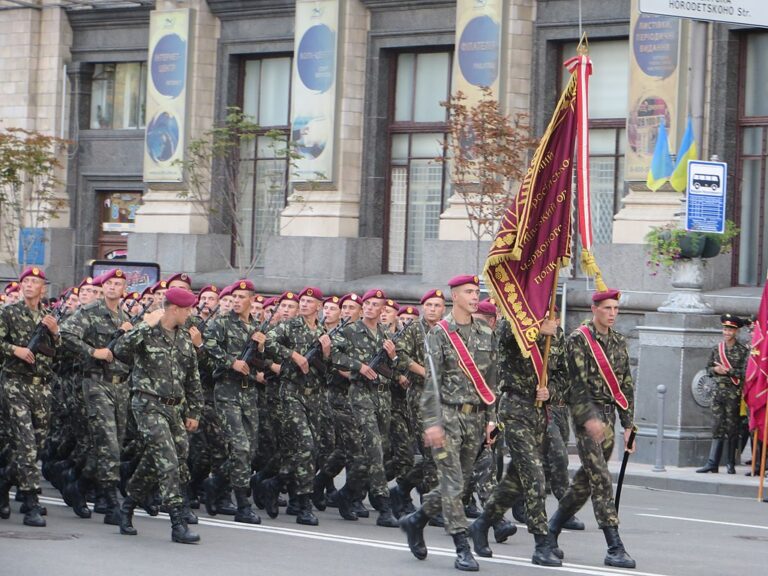
Military parade marking Ukraine’s Independence Day. Kyiv, 2001
The year 2001 was the most memorable—the 10th anniversary of Ukraine’s independence. At that time, 6,500 military personnel marched down Kyiv’s main street, 173 pieces of military equipment drove past, and an AN-124 “Ruslan” and Ukraine’s pride—the AN-225 “Mriya”—flew over the capital. Parades were also held in Lviv, Vinnytsia, Odesa, Chernihiv, and Sevastopol.
However, by the middle of the decade, the nature of the celebrations had changed dramatically. Starting in 2005, the focus shifted to military band performances and folk culture. It was during this period that the tradition of attending festive events in national dress began. The vyshyvanka transformed from a museum exhibit into the main dress code of the holiday for millions of Ukrainians.
In the Donetsk region, Ukraine’s Independence Day often coincided with one of the region’s most important professional holidays—Miners’ Day—which led to certain adjustments in how it was celebrated. Since the 1990s in the Donetsk region were marked by widespread wage arrears and large-scale strikes, holidays often became an occasion for protests.
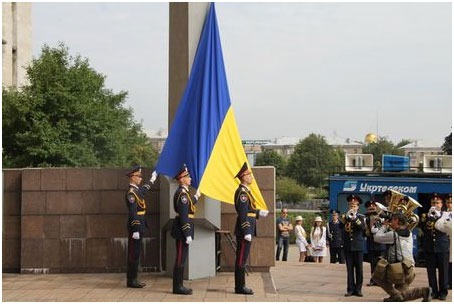
Ceremony to Raise the National Flag of Ukraine in Donetsk, 2011
However, by the early 2000s, the miners’ movement had begun to wane, and the focus of the main national holiday celebrations shifted accordingly. A tradition of large-scale local celebrations emerged. In Donetsk, Mariupol, and Sloviansk, parades featuring traditional embroidered shirts and fairs showcasing Ukrainian crafts were organized to mark Ukraine’s Independence Day.
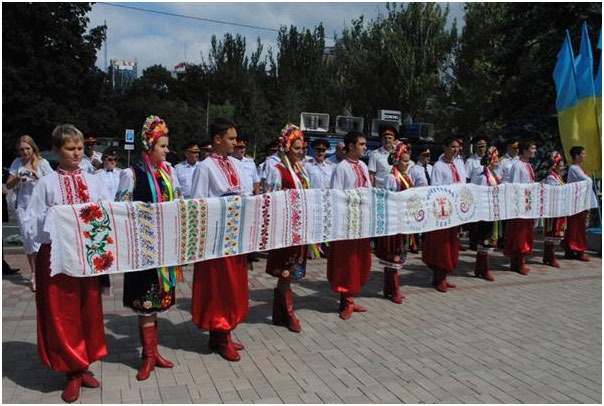
Presentation of the “Towel of Unity” for Ukraine’s Independence Day in Donetsk, 2011
The “Circle of Friends” ethno-national festival has become a tradition in Donetsk. As part of the event, traditional dishes, baked goods, and beverages from various ethnic groups residing in the Donetsk region (Ukrainians, Greeks from the Azov region, Germans, Belarusians, Armenians, and others) were showcased. In addition, there were exhibitions of decorative and applied arts, folk crafts, household items, and amulets; folklore performances by artistic groups; master classes; and a fashion show featuring traditional national costumes.
The highlight of the celebrations in the heart of the region for Ukraine’s Independence Day, Donetsk City Day, and Miners’ Day was the annual “Roses of Donetsk Region” festival, which featured sports races, flower exhibitions, fairs, and concerts in Shcherbakov Park. In the mid-2000s, youth car and bicycle races gained popularity.
In August 2011, to mark the 20th anniversary of Ukraine’s independence, Donetsk hosted the finale of a large-scale campaign to create the “Towel of Unity” as part of the nationwide project “United Ukraine: East and West Together.” The finished towel was ceremoniously unveiled near the monument to Taras Shevchenko, where the project had begun. It is noted that the towel is embroidered with poppies, cornflowers, roses, and sunflowers. The colors used are characteristic of the Donetsk region: black, red, blue, and yellow-green. Afterward, the towel traveled through all regions of Ukraine, where local artisans added their own embroidered designs. The length of this unique embroidered cloth is 8.5 meters, and its width is 60 centimeters. As Artem Lovyagin, a methodologist at the Donetsk Regional Educational and Methodological Center for Culture, noted, “The towel is a symbol of our region’s unity. The artisans poured all their love into it—not only for their region but also for Ukraine, because the towel is a symbol of Ukraine.”
Ukraine’s Independence Day was celebrated in grand style in Donetsk in 2013 as well… But just one year later, the city was occupied by Russian militants.