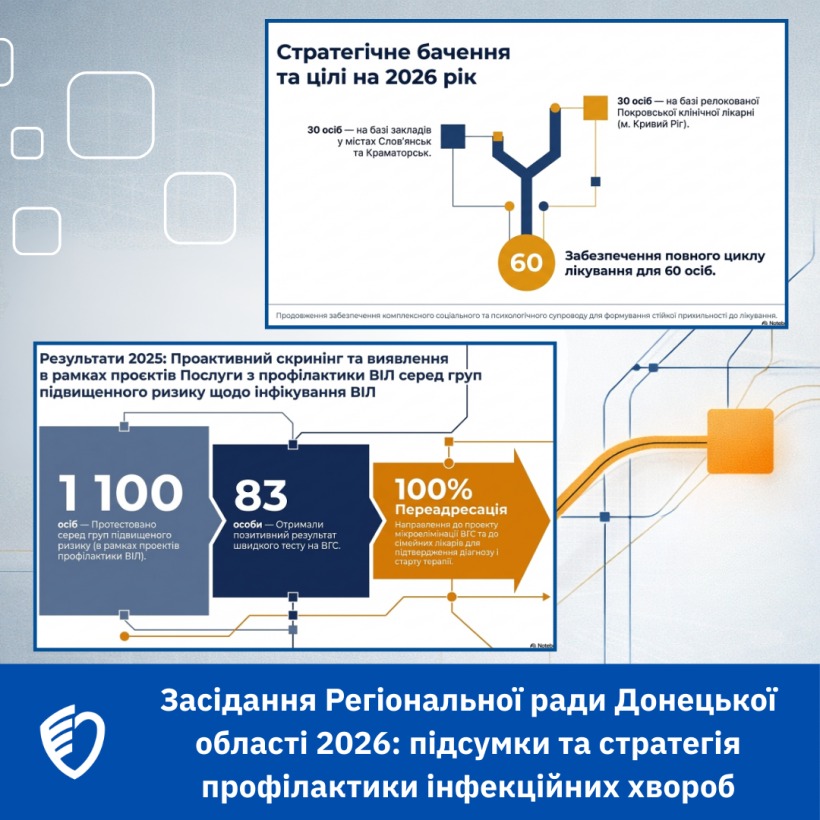
On March 16, 2026, a scheduled meeting of the Regional Council on Tuberculosis and HIV/AIDS Prevention (hereinafter referred to as the Council) was held online.
The meeting was chaired by the Council’s Deputy Chair, Director General of the State Institution “Donetsk Regional Center for Disease Control and Prevention of the Ministry of Health of Ukraine,” and Chief State Sanitary Doctor of Donetsk Oblast, Serhiy Leonidovych Skrypnyk.
The main purpose of the meeting:
To discuss current issues regarding the implementation of measures for the prevention and control of infectious diseases in accordance with the State Strategy for Combating HIV/AIDS, Tuberculosis, and Viral Hepatitis in the region for the period up to 2030, as well as to analyze existing problems and identify ways to resolve them.
The following reports were presented at the Council meeting:
- regarding the results of monitoring visits concerning the implementation of tuberculosis infection control measures in healthcare facilities in the Donetsk region for 2025;
- review of the status of implementation of measures aimed at realizing the National Strategy for Combating HIV/AIDS, Tuberculosis, and Viral Hepatitis for the period up to 2030;
- regarding the implementation of the project on the micro-elimination of viral hepatitis C among key populations. Current issues and barriers in the diagnosis and treatment of hepatitis C in the Donetsk region were discussed.
Proposals and decisions:
After hearing the reports, the Council members discussed proposals for further action and their inclusion in the meeting’s protocol decision.
The protocol decision, approved by the Council Chair—First Deputy Head of the Regional State Administration Y.O. Vinokurov—will be forwarded for implementation to all relevant entities: Council members, relevant departments of the Regional State Administration and municipal military administrations, healthcare facilities, and civil society organizations.
The adopted decision will serve as a practical tool for coordinating actions among government agencies, medical institutions, and civil society organizations. It aims to strengthen prevention, improve diagnosis, and ensure accessible treatment for tuberculosis, HIV/AIDS, and viral hepatitis in the Donetsk region.