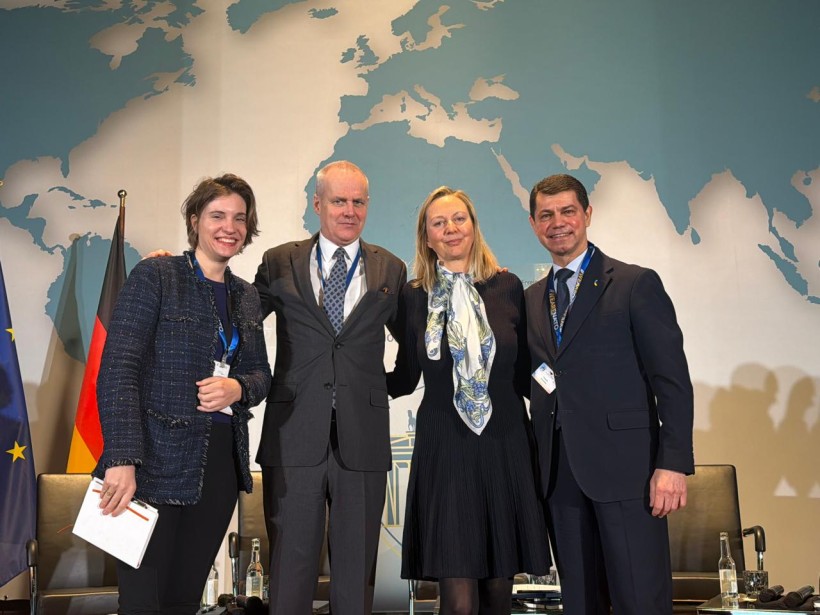
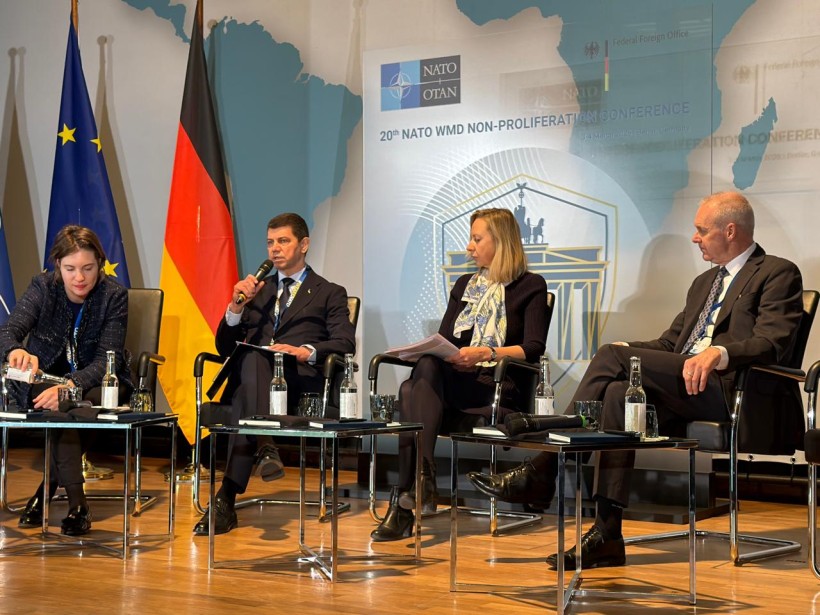
Deputy Minister of Foreign Affairs of Ukraine Oleksandr Mishchenko Participates in the 20th NATO Conference on Weapons of Mass Destruction Non-Proliferation, Arms Control and Disarmament in Berlin.
Deputy Minister of Foreign Affairs of Ukraine Oleksandr Mishchenko took part in the 20th NATO Conference on Weapons of Mass Destruction (WMD) Non-Proliferation, Arms Control and Disarmament, held in Berlin.
The NATO Conference on WMD Non-Proliferation, Arms Control and Disarmament is an annual event that brings together senior officials from Allied and partner nations, representatives of international organisations, the expert community, and civil society to discuss current challenges in international security, as well as measures aimed at strengthening strategic stability in the Euro-Atlantic area.
This year’s conference gathered senior NATO and Allied officials, including NATO Assistant Secretary General for Political Affairs and Security Policy Boris Ruge and State Secretary of the Federal Foreign Office of Germany Géza Andreas von Geyr. Ukraine was represented at the event by Deputy Minister Oleksandr Mishchenko.
The conference was opened by State Secretary Géza Andreas von Geyr, who emphasised in his remarks that, despite the escalation of the situation in the Middle East and other global challenges, support for Ukraine in its fight against Russian aggression remains an unwavering priority for Germany and will continue to be at the centre of German foreign policy.
NATO Secretary General Mark Rutte also addressed the participants via video message.
Oleksandr Mishchenko participated in the thematic panel entitled “Ensuring Freedom and Safeguarding Stability: Euro-Atlantic Security in a New Strategic Era”.
In his statement, the Deputy Minister underscored that strategic stability in the Euro-Atlantic area directly depends on resolute and long-term support for Ukraine in its heroic struggle against Russian aggression. The Ukrainian diplomat stressed that appeasement of the aggressor state — the Russian Federation — and attempts to equate the victim with the aggressor constitute a misguided approach that only exacerbates threats to the entire European community.
Oleksandr Mishchenko placed particular emphasis on the need to enhance military, financial, energy and humanitarian assistance to Ukraine; to strengthen the sanctions regime imposed on the aggressor state and prevent its circumvention, including through stricter control over the supply of dual-use goods to third countries and countering the Russian Federation’s “shadow fleet”. The Deputy Minister stressed that sustained support for Ukraine and the reinforcement of its defence capabilities are key to safeguarding European values, achieving a just and lasting peace for Ukraine, and, consequently, ensuring a secure future for the entire European continent.
On the margins of the conference, Oleksandr Mishchenko held a working meeting with NATO Assistant Secretary General for Political Affairs and Security Policy Boris Ruge. The parties discussed further Allied support for Ukraine in the context of ongoing Russian aggression, including through intensified engagement within the framework of the PURL initiative and the mobilisation of additional financial contributions to strengthen Ukraine’s defence capabilities.
* according to information published on the https://mfa.gov.ua/tag/nato?&type=all&tags=%D0%9D%D0%90%D0%A2%D0%9E